- About Archives
- About SAA
- Careers
- Education
- Publications
- Advocacy
- Membership


I aim to build a strong, diverse, and empowered pool of candidates who not only represent the breadth of our membership but also champion the Society's values of inclusion and belonging.
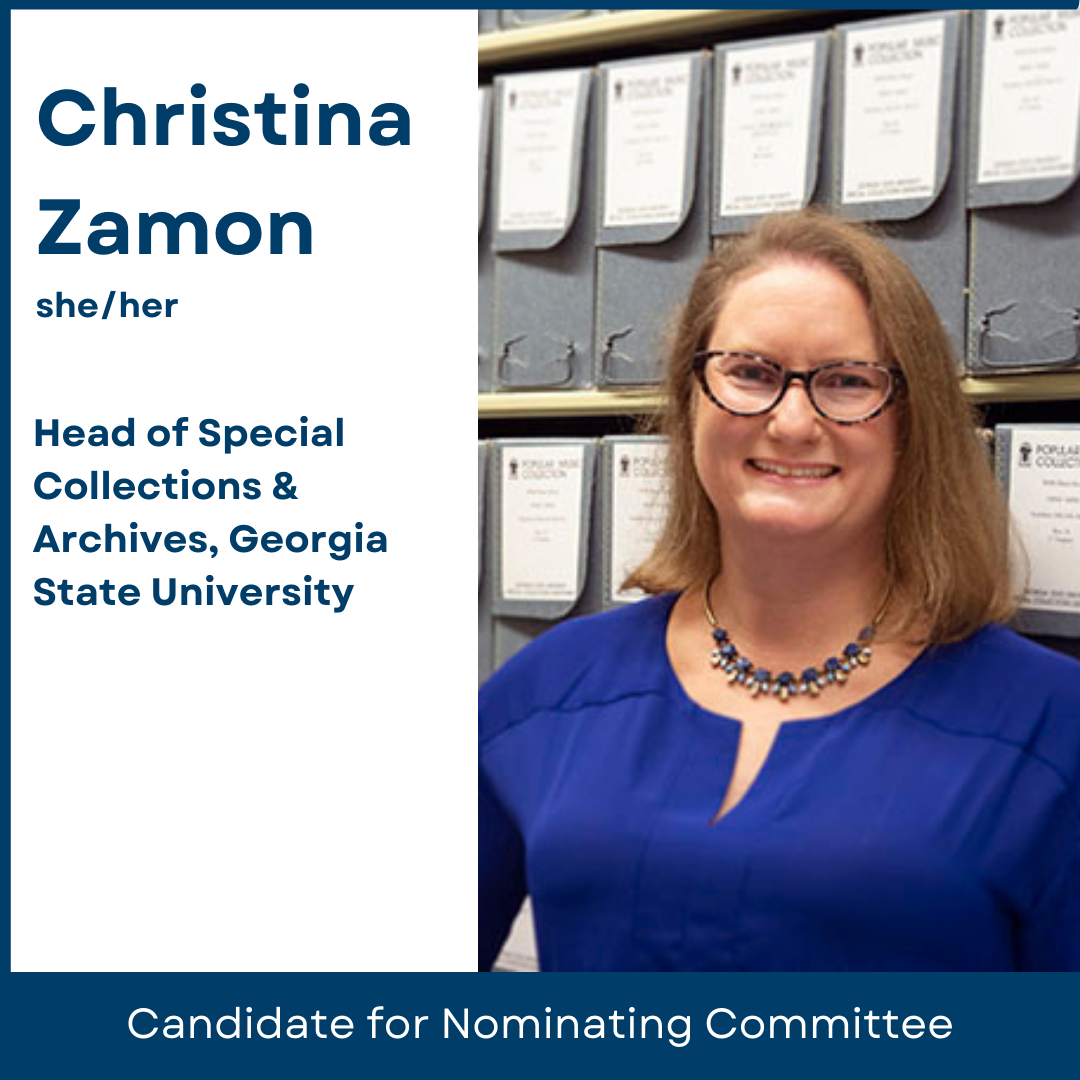
Christina Zamon is currently the Head of Special Collections & Archives at Georgia State University. Prior to that, she worked at Emerson College, the National Press Club, the Folger Shakespeare Library, and the Frick Art Reference Library. She is an SAA Fellow and has over 25 years of experience working in archives and special libraries. She is the author of The Lone Arranger: Succeeding in a Small Repository and Alone in the Stacks: Succeeding as a Solo Archivist. She received her MA in History and MLIS from the University of Maryland where she worked as a graduate assistant in the library's Preservation Department.
CANDIDATE'S RESPONSE
When certain voices dominate, I will intervene early to reset the tone and create structured space for participation. I will begin by pausing the discussion and recentering us on the mission, vision, and goals of SAA so contributions are framed by shared purpose rather than personality or hierarchy. I will then shift to facilitation techniques that surface broader input: brief rounds where each person is invited to speak so on one voice unintentionally consumes the conversation. I will proactively invite perspectives across career stages and identities—students, new professionals, mid career colleagues, and late career archivists—because combining institutional history with new ideas yields stronger, future focused outcomes. I will use targeted prompts to ensure specific vantage points are heard. When dynamics get tense, I will restate points neutrally, acknowledge emotions, and summarize areas of agreement and divergence, which helps the group move from advocacy to inquiry. Clear ground rules—assume positive intent, critique ideas not people, one mic at a time—are revisited as needed.
CANDIDATE'S RESPONSE
My strategy for inspiring members to run for leadership positions and actively engage in the election process centers on intentional outreach, transparent communication, and fostering a sense of shared purpose. I will begin by engaging members at all career stages—new professionals, mid‑career members, and seasoned leaders—so that everyone understands that their voice and experience are valued and needed. During recruitment conversations, I will highlight the Society's mission and goals, emphasizing that service in governance is one of the most meaningful ways to move the organization forward.To cultivate genuine engagement, I will focus on explaining not just what leadership roles entail, but why members' participation matters. I frame governance as an opportunity to shape the Society's future, broaden representation, and bring forward the diverse perspectives of our membership. This includes proactively reaching out to members across a wide variety of work settings and backgrounds to help them see themselves reflected in leadership and feel confident that their lived experiences are assets to the Society's governance. Ensuring a slate that reflects awareness of power, positionality, inclusion, and belonging requires purposeful and equitable recruitment practices. I will do this by actively inviting members whose voices have been historically underrepresented, discussing the importance of inclusive leadership, and creating supportive pathways for those who may not have previously considered running. By acknowledging how power and positionality shape our professional environments, I will work to ensure that leadership opportunities are accessible, transparent, and grounded in the Society's commitment to equity.Through these strategies, I aim to build a strong, diverse, and empowered pool of candidates who not only represent the breadth of our membership but also champion the Society's values of inclusion and belonging.
|
The Nominating Committee has slated the following SAA members as candidates for office in the 2026 election: Vice President/President-Elect
Council
Nominating Committee
|