- About Archives
- About SAA
- Careers
- Education
- Publications
- Advocacy
- Membership


I…hold that following democratic processes is necessary to tear down systemic barriers that exclude marginalized people from holding positions of power and making positive change. …Thus, paving the way for historically excluded persons to run for SAA office is necessary to change the profession for the benefit of all.
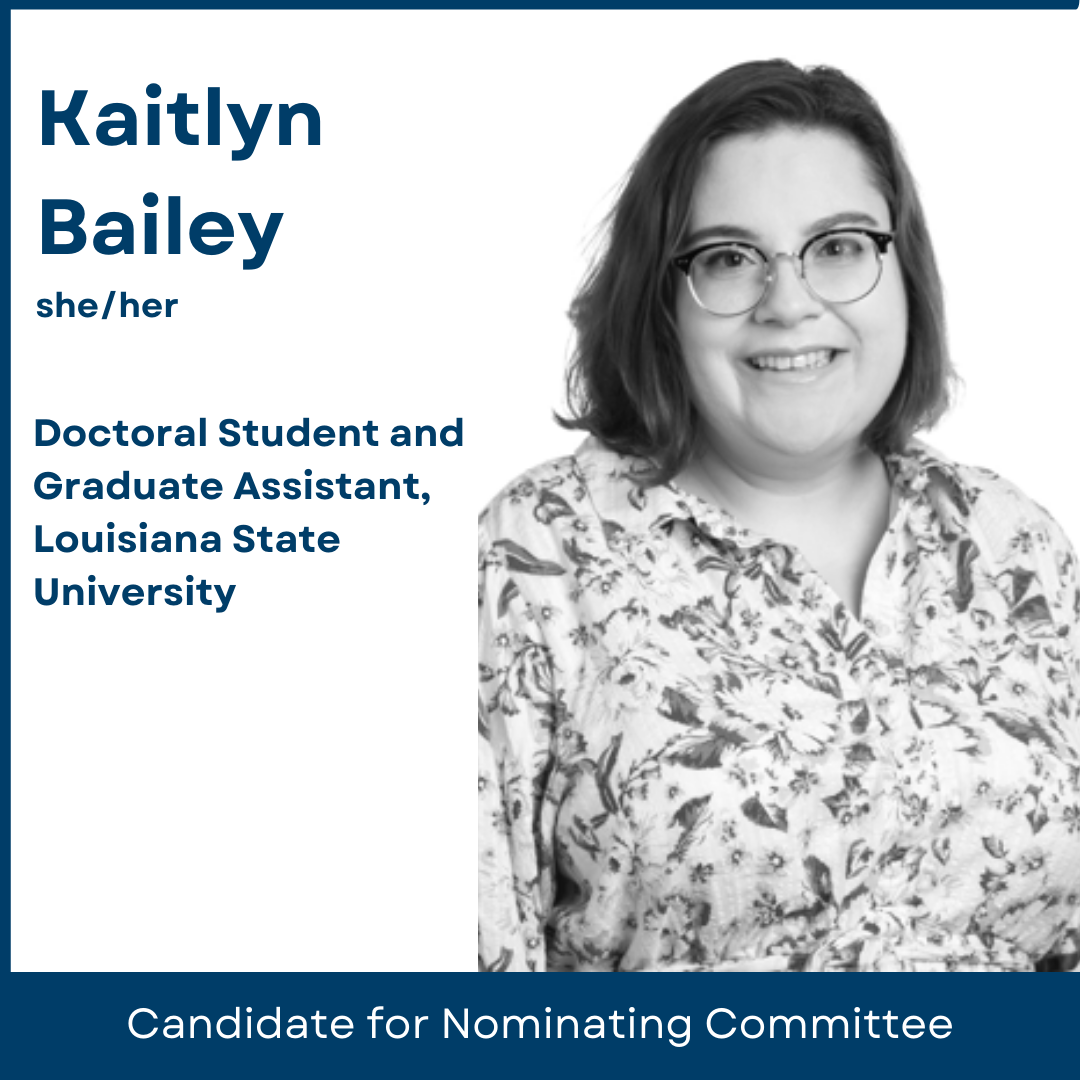
Currently I am a student in Louisiana State University's Doctor of Design in Cultural Preservation program, and my concentration is in Museum and Archival Studies. I also work as a graduate assistant with the LSU School of Information Studies. I have received my B.A. in History from Ashland University, and my M.A. in American History, MLIS, and Graduate Archival Certificate all from Louisiana State University. My research focuses on the cultural and historical applications of GIS. Previously, I have worked on PROTECCT-GLAM, a project with the goal of mapping every cultural heritage institution in the United States and their associated climate risks. My doctoral thesis, Le Tirage: Mapping Civil War New Orleans, involves plotting the residences and workplaces of the New Orleans men drafted by the Union Army in 1865. By mapping the lives of these men, I am calling attention to the experiences of working class and non-white draftees who have been ignored in the historical narrative. In my research, I explore how GIS technology can be used to bring to light voices lost in archival silences.
For the past three years, I have had the honor to preserve Southern Jewish history in my role with the William Breman Jewish Heritage Museum's Esther and Herbert Taylor Oral History Project. This role has reinforced my interest in highlighting the voices of communities who have been historically underrepresented in archives. I also currently serve on the LSU Rural Life Museum Board of Trustees. In this role, I help make collections decisions and policy. For the past four years, I have also been an instructor with LSU's Ochsner Lifelong Learning Institute, and have taught classes on history and Louisiana culture. Outside of archives and museums, I am a local community organizer, and lead mutual aid projects addressing the hunger, clothing, and transportation needs of underserved Louisianans.
CANDIDATE'S RESPONSE
I have experienced this phenomenon before with my continuing education students. Some of my students are especially eager to participate and tend to dominate the conversation. In the past, this has led the other students feeling as though their contributions do not have value, when the opposite is true. The solution to this issue is two-fold and involves creating a culture of inclusion and structuring conversations to facilitate equal involvement.
To create a culture of inclusion, those who hold positions of authority must first look inward at their own positionality, and acknowledge the value of other perspectives. As a white queer woman, I would first acknowledge my own identities and how they frame my worldview before proceeding. I would also emphasize the importance of all sharing their voice in professional settings. Conversations can only benefit from a diversity in opinion, just as organizations can only benefit from a diversity in membership. I would also acknowledge the agency of all participants and their power to create positive change. Centering marginalized voices is necessary to overcome the historic barriers that have been placed to exclude, remove, and silence. Furthermore, those in positions of power must listen to those who have been silenced, and their needs, to implement solutions that promote equality.
A culture of inclusion must be supported by structuring conversations. I found that, in my classroom, when the conversation had less structure, a few students tended to dominate the discussion. After all were encouraged to participate, I began implementing a hand-raising rule and would ask quieter students about their opinions in class. While hand raising may not be useful in all environments, it can help contributors feel comfortable joining the conversation. Occasionally diverting the conversation to ask quieter participants about their opinions is also a good way to encourage equal involvement and make all feel heard. I would also make myself available to hear opinions in private. Not everyone is comfortable speaking publicly, and it is vital that their needs are also met. These are the steps that I would follow to ensure that all voices are valued and heard.
CANDIDATE'S RESPONSE
I believe that a democratic organization like the SAA is only strong if its membership is actively involved in its leadership. I also hold that following democratic processes is necessary to tear down systemic barriers that exclude marginalized people from holding positions of power and making positive change. Disenfranchised communities have their own unique experiences and it is their members who should represent these community perspectives. Professional organizations, like the SAA, have historically been weaponized to keep the archival profession white, straight, cis, and male dominated. Thus, paving the way for historically excluded persons to run for SAA office is necessary to change the profession for the benefit of all. Furthermore, the organization is stagnant when the same group of officeholders repeatedly win elections. New perspectives are necessary to propel the SAA forward. These are some of the talking points that I would use to inspire my fellow members to run for office.
Strategically, I would work with the members of the nominating committee to identify potential candidates who center marginalized voices in their research, and in their professional and personal lives. I would also look to see if a candidate has held SAA offices in the past, and which ones. It is important to balance fresh perspectives with experience when forming a slate of candidates. I also anticipate that many of these candidates will have busy professional lives, and that they may not have time to run for office. However, I would stress to them the fact that holding an SAA office is not a mere professional accomplishment, and it is worth the time invested to run. It is an opportunity to create real systemic change within the profession by shaping it for the benefit of all archivists. Such change is only possible if SAA members, like them, are willing to step up and lead.
|
The Nominating Committee has slated the following SAA members as candidates for office in the 2026 election: Vice President/President-Elect
Council
Nominating Committee
|