- About Archives
- About SAA
- Careers
- Education
- Publications
- Advocacy
- Membership


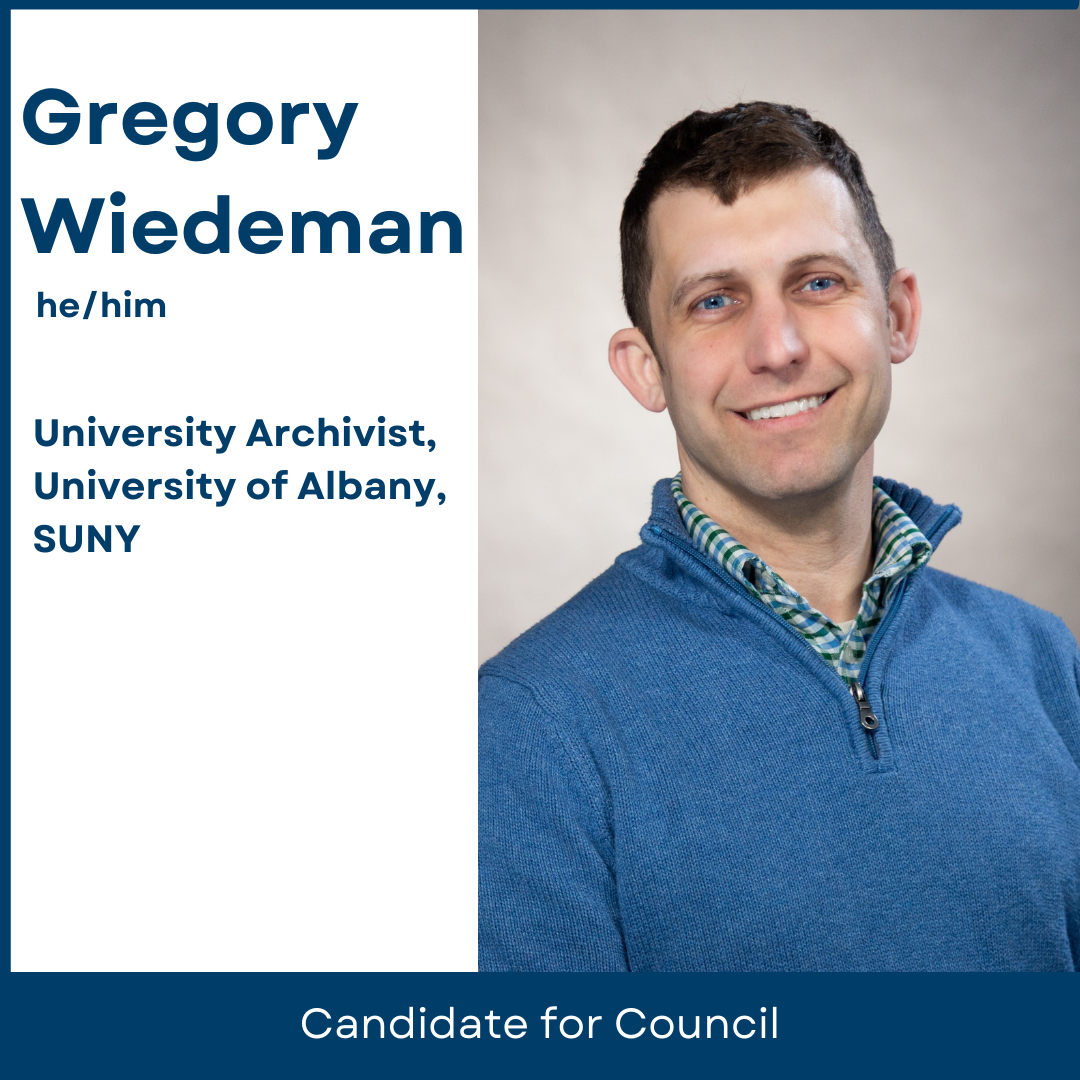
Meaningful change requires trust, stability, and clear communication. Reexamining our priorities, as SAA must do, has to be built on a foundation where people feel valued, secure, and heard.
I started in archives as a student worker, by spending 40 hours a week one summer proofing folder inventories. The collection was already refoldered with titles typed into a spreadsheet. I was merely ensuring the titles matched in the right order. This was a good job at the time, but I knew then I didn't want to be an archivist. It was only after I was able to take on more challenging work, like describing weird audio formats, digitizing glass plate negatives, or helping a researcher find where a building was from traditional surveying units that I discovered how genuinely fun archives work can be.
I really like talking to archivists about how to make our work better. I am fortunate that research and service are part of my role, so I have had the incredible opportunity to speak with and learn from many thoughtful and creative archivists and to bring those ideas back to our local practices. Since most of us have limited to no technology support, I have focused on filling that gap and I think my best work has been communicating between archivists and technologists about how to build systems that leverage archival principles to better serve our users.
Our profession is under constant resource pressure. During the twelve years I have worked at my current institution, the library has lost more than a third of its staff. I served twice as faculty chair during some of the most difficult periods, often acting as a bridge between colleagues who rightly felt their work was undervalued and administrators under pressure to show innovative reforms. These experiences taught me that meaningful change requires trust, stability, and clear communication. Reexamining our priorities, as SAA must do, has to be built on a foundation where people feel valued, secure, and heard.
CANDIDATE'S RESPONSE
I think inclusivity starts with infrastructure. Establishing a clear standard of participation that addresses the power dynamics that exist in our spaces sets the right tone. Communication spaces then have to be intentionally designed with some structure. The complexity can scale up or down, but it should include clear "swimlanes" for participation so people unfamiliar with the culture are clearly invited and know when to step in, along with boundaries that prevent others from crowding those lanes. Structure only works if there are mechanisms to uphold it, and it is essential that we recognize, support, and empower facilitators to intervene when needed and sustain healthy participation across all kinds of spaces.
The onus is always on the empowered—the organization and people like me—to make space for others, particularly when we encounter ideas that challenge us. This makes us organizationally healthier. The goal is not just to hear everyone, but to more broadly distribute the power to shape decisions and outcomes.
While I have tried to make the spaces I help shape more inclusive, this is ongoing work, and I will always be learning from others. It doesn't take much to put in some effort to learn from proven approaches and plan ahead for more inclusive participation. SAA can draw on well-established practices from peer organizations like DLF and Code4Lib, which have been ahead of us in this work for years.
It remains urgent to address the structural barriers to our professional spaces that matter most. I am extremely fortunate to be an archivist and to have travel support and service as part of working hours. One of my parents was a bookkeeper for my undergraduate college, so I didn't pay tuition. Without that, pursuing graduate school—let alone two master's degrees—would have seemed unrealistic. There are many, many higher barriers than this as well, and the people who overcome them are those who I want to follow.
Addressing economic, social, and other hurdles is essential for impactful archives work. Effective archival practice requires being in community with the people we document, and sometimes who we are matters. A more diverse profession is more effective at repairing harmful description, avoiding repeating these mistakes, and building trust. When people see themselves in collections and among archivists, they are more likely to engage with archives. Strengthening participation from underrepresented groups is not just eyewash, it is how we do better archival work.
CANDIDATE'S RESPONSE
This is a challenging time for professional organizations, and SAA is particularly vulnerable because it relies so heavily on individual members. The Society has already begun reexamining its finances and strategic vision, but stronger communication with the membership is essential. Members need to see that no stone is being left unturned, because only from that foundation can we hear from membership and productively reexamine SAA's focus and priorities.
My primary priority as a council member would be to help build a more open, transparent, and healthier culture at SAA. There seems to be contentious discussions among people I deeply respect, but it is entirely opaque what paths are being debated and how decisions are reached. I think each of the last handful of presidential addresses talked about conflict among council that the membership has no awareness of. A culture that keeps these processes hidden limits members' ability to provide informed feedback, and hinders trust and meaningful engagement. Council deals with hard problems with no clear solutions. I want to make the processes for adjudicating these issues more healthier, collaborative, and transparent.
SAA has recently struggled to balance inclusivity and financial health, but if we take a step back, inclusivity and financial health should be aligned. I deeply value the informal, generative collaboration of an in-person conference, especially hearing from new voices, while recognizing that the annual meeting is only fully accessible to a small portion of current and potential membership. I support returning to an in-person Annual Meeting, as hybrid meetings have not proven to be a sustainable or effective way to create a truly inclusive SAA. In what feels like an increasingly isolated society, I value the connections I've made and the energy that comes from them more than ever, and I look forward to the privilege of meeting more archivists in future years.
However, this must be the beginning of a transition rather than its endpoint. SAA must creatively foster remote professional spaces that go beyond Zoom webinars to support the informal collaboration, learning, networking and engagement that make the in-person meeting so valuable. There are many emerging professionals and others without access to the Annual Meeting who we need to serve. For this reason, I am strongly opposed to bringing SAA component group meetings back to the Annual Meeting. Section meetings have been where experimentation in remote participation has begun, creating more inclusive spaces for engagement. We should build on these efforts and continue learning from our peer organizations.
As a council member, I would prioritize clearer communication around decision-making, including regular explanations of major tradeoffs and strategic options under consideration. I would also advocate for structured experimentation with new forms of remote participation beyond the annual meeting. I would actively communicate with Section leaders about what is working and what is not, and work to establish processes that support iterative experimentation and shared learning throughout SAA as we look to build out inclusive professional spaces that are accessible
|
The Nominating Committee has slated the following SAA members as candidates for office in the 2026 election: Vice President/President-Elect
Council
Nominating Committee
|