- About Archives
- About SAA
- Careers
- Education
- Publications
- Advocacy
- Membership


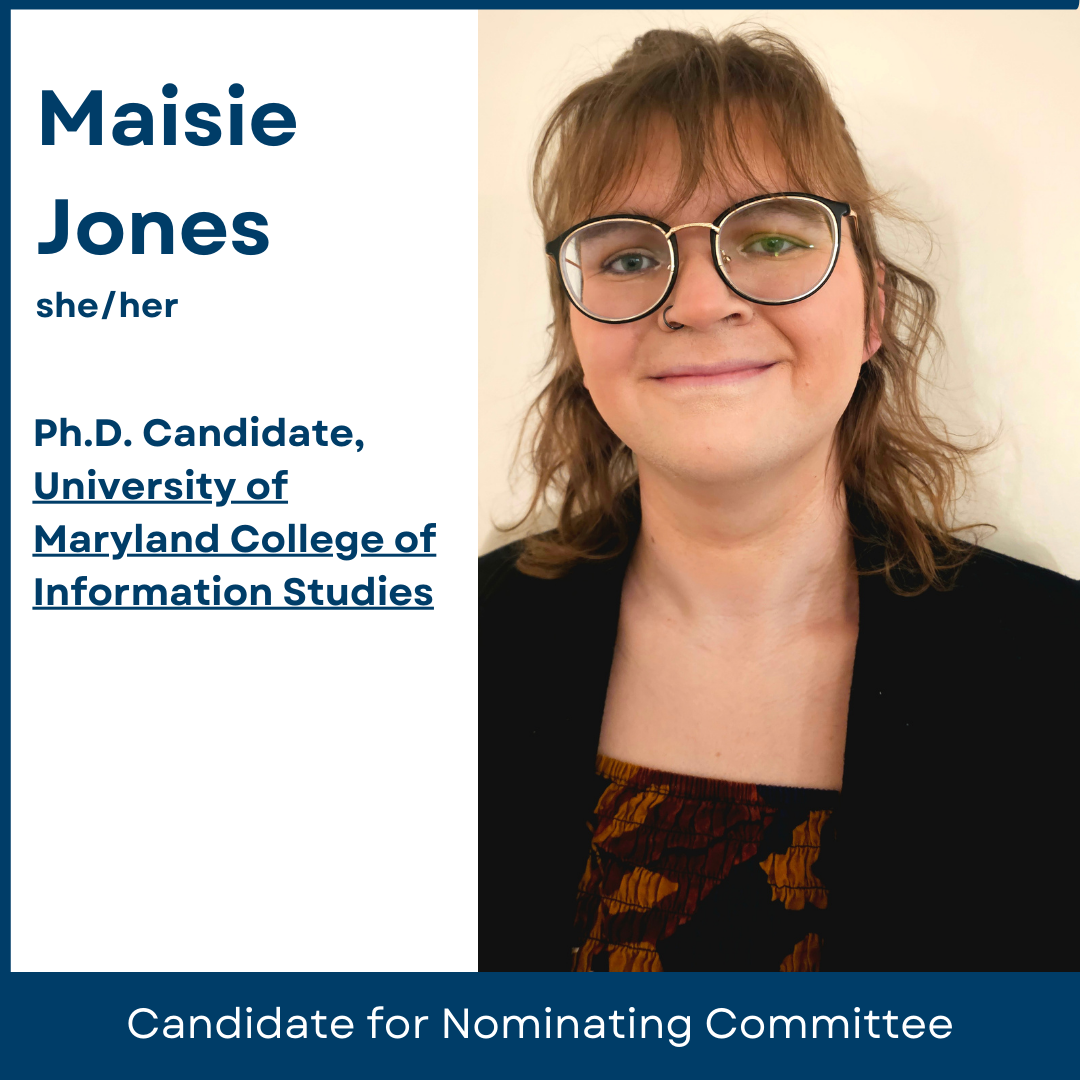
Maisie Jones is a Ph.D. candidate in Information at the University of Maryland. Her research is highly focused on digital accessibility, description, and information structures in archives and special collections. She holds an MLIS from the University of Alabama with a concentration in archives. Jones has published research pertaining to archival work in journals such as the Journal of Contemporary Archival Studies and featured research on archival materials in journals such as the Journal of Critical Digital Librarianship and the Journal of Open Humanities Data.
CANDIDATE'S RESPONSE
I have worked with a wide range of communities in professional and personal capacities, including LGBT+ and disabled communities. I am committed to lifelong learning about people with whom I do and do not share identity, religion, background, region, or cultural experiences. My life has been made immeasurably better by being in community with a diverse range of people professionally and in my personal life. Growing those connections, making new connections, and building space for everyone to be heard is critical to me.
I have worked with a wide range of communities in professional and personal capacities, including LGBT+ and disabled communities. I am committed to lifelong learning about people with whom I do and do not share identity, religion, background, region, or cultural experiences. My life has been made immeasurably better by being in community with a diverse range of people professionally and in my personal life. Growing those connections, making new connections, and building space for everyone to be heard is critical to me.
CANDIDATE'S RESPONSE
Inspiring others to fill leadership roles and balancing competing internal priorities is a task which cannot be managed alone. Working with others to understand personal and institutional needs is critical to success, especially in large and complex organizations like SAA.
In specific, I hope to continue engagement with archivists about the immediate and developing needs of the profession, especially during a time of significant uncertainty. Improving transparency requires being in clear and direct communication with leaders in the field and with those joining the field as paraprofessionals or archives students. Understanding what existing needs are and meeting those needs with direct and meaningful organizational structures, programming, and developing SAA to maintain its role as a center for professional thought, values, and community.
Promoting the value of leadership and service is difficult and nuanced. To be successful in this requires the ability to converse with practitioners and academics working in and around the archives field. As a scholar-practitioner, I leverage the connections I have made between academic and professional circles. I aim to provide open and transparent information about service and leadership positions and add more interactivity and meaningful feedback during the election process. Enabling leadership to be more than a professional obligation requires that those roles be understood as providing value to the profession directly by influencing the largest and most comprehensive professional organization in archives. Leadership is inherently complex and can happen at various points in a person's career. Being more aware of the challenges facing people at different stages working within a complex time and bringing that awareness to bear in how we connect with others as an organization will grow involvement and demonstrate a grounded, pragmatic, yet hopeful vision for the profession.
|
The Nominating Committee has slated the following SAA members as candidates for office in the 2026 election: Vice President/President-Elect
Council
Nominating Committee
|