- About Archives
- About SAA
- Careers
- Education
- Publications
- Advocacy
- Membership


Having more robust and responsive advocacy tools will ensure SAA doesn't just respond to this moment, but equips its members to lead through it.
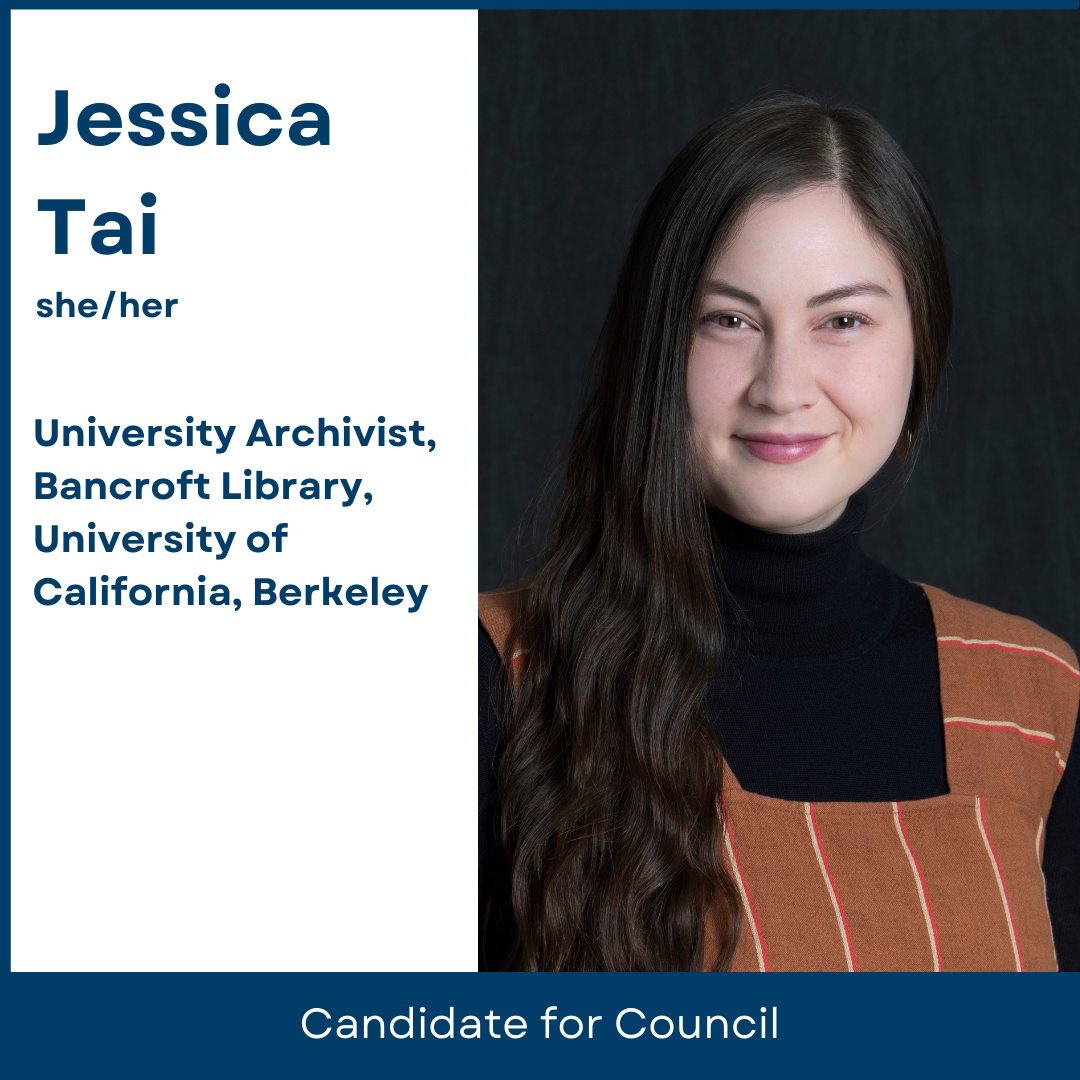
I am the University Archivist at the Bancroft Library, University of California, Berkeley, where I lead the acquisition and stewardship of university archives and faculty papers. My background as a processing archivist deeply informs my current curatorial work. I am driven by a total cost of stewardship framework, prioritizing responsible, holistic, and sustainable collecting practices. In this role, I prioritize outreach and relationship-building with communities and student groups whose histories have traditionally been absent from university archives or documented without their own perspectives. I have been active in SAA since I was awarded the Mosaic scholarship and Pinkett award during my graduate program. I have served in several leadership capacities, including most recently as chair of the 2025 Nominating Committee, where I helped shape the slate of candidates for SAA's elected leadership. My previous service includes appointments on the 2023 Harold T. Pinkett Award Committee, the 2020 Program Committee, and as a member-at-large for the Visual Materials Section.Much of my early career focused on developing and advocating for the implementation of reparative archival description within special collections and archives. I have undertaken this work through a variety of means, including: chairing the Reparative Archival Description Working Group at Yale Library, teaching workshops, writing articles, and participating in panels. I have also presented at conferences on topics including archival debt, documenting student activist movements, archival ethics, community archives, and cultural humility.
CANDIDATE'S RESPONSE
When certain voices tend to dominate conversations, I take an intentional and actionable approach to inclusion, focusing on removing barriers and actively creating space for others to contribute. Inclusive leadership requires designing processes that lower participation thresholds and reduce power dynamics.
For example, while serving on the Harold T. Pinkett Student of Color Award Committee in 2023, I recognized that requirements such as official transcripts and letters of recommendation created unnecessary barriers for many applicants. I proposed removing these requirements to broaden access, and the committee adopted the change. As a result, applications increased by 300% from the previous year.
This experience reinforced for me that when we simplify processes and examine who we may be unintentionally excluding, we can meaningfully expand opportunities for non-dominant voices to emerge. If elected to Council, I will continue to advocate for policies and workflows that lower barriers to participation and create more accessible routes to leadership within SAA.
CANDIDATE'S RESPONSE
We are living and working through an extraordinarily challenging moment for archives. Cultural institutions are under increasing political and financial pressure, and archivists are charged with documenting histories at the same time that those histories are being contested, erased, or actively attacked. SAA's relevance depends on its ability to be responsive, transparent, and supportive of its members while advancing its strategic priorities.
If elected to council, I would prioritize making SAA's advocacy resources more actionable for members. This aligns directly with Goal 1 of SAA's Strategic Plan: Advocating for Archives and Archivists. While Council statements play an important role in signaling important values and positions to its members, there is an opportunity to extend this work by translating statements into practical tools. I would support a strengthening of the advocacy section of the SAA website to include toolkits, working documents, and organizing resources that members can use in their own institutions. For instance, members currently navigating federal grant cancellations or facing institutional pressure to censor exhibit content need timely, actionable guidance and resources – and having more robust and responsive advocacy tools will ensure SAA doesn't just respond to this moment, but equips its members to lead through it.
Finally, Council has a responsibility to communicate clearly about fiscal priorities and constraints, particularly around budgeting, conference planning, and resource allocation. Making decision-making processes more visible helps members understand how choices are made and where their input can have the greatest impact.
|
The Nominating Committee has slated the following SAA members as candidates for office in the 2026 election: Vice President/President-Elect
Council
Nominating Committee
|