- About Archives
- About SAA
- Careers
- Education
- Publications
- Advocacy
- Membership


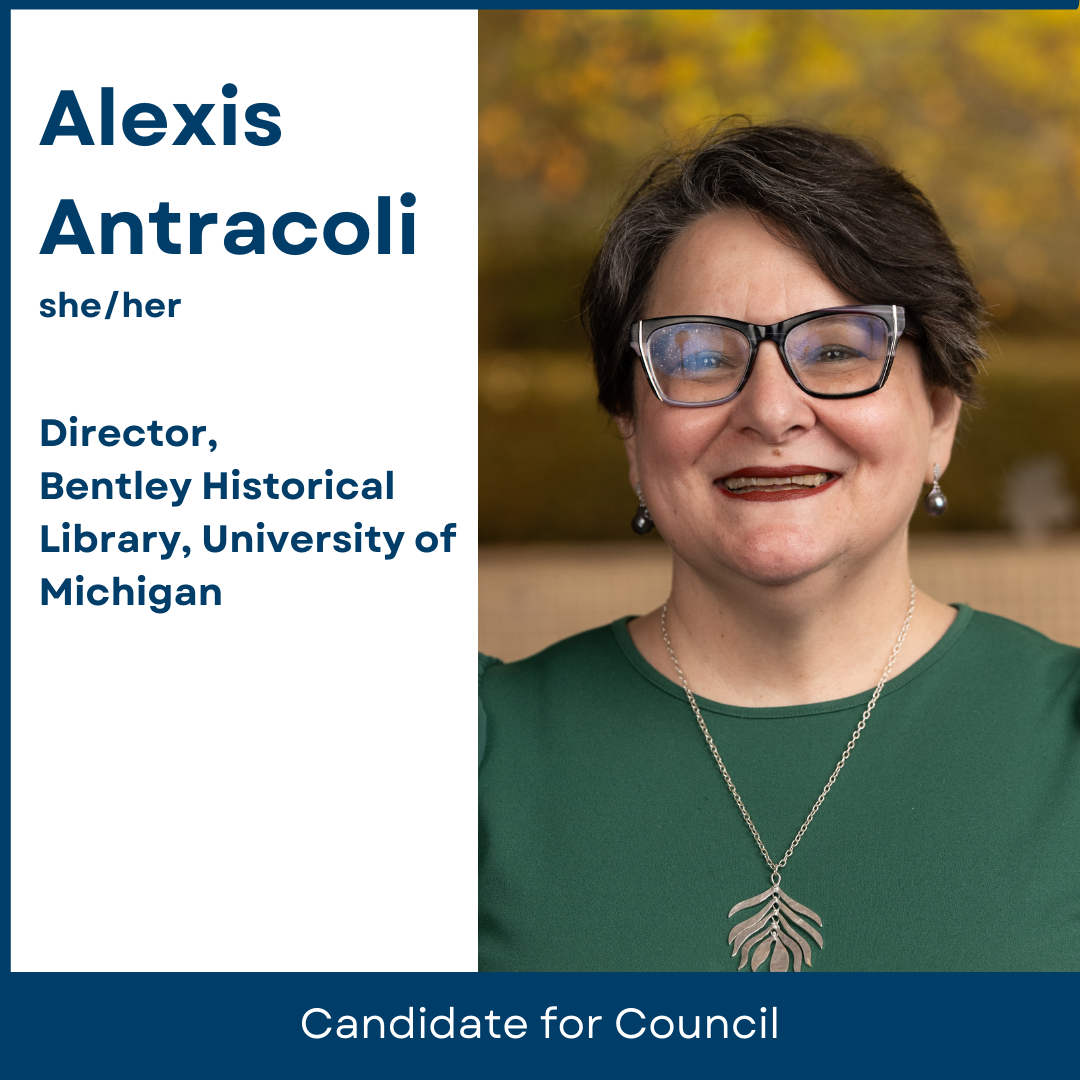
In order to remain a leader for the archival profession, SAA must be able to meet the needs of its members, develop future leaders for the field, and advocate for the value of our work. I would center my efforts on these three core values articulated in the strategic plan.
I am currently the Director of the University of Michigan Bentley Historical Library, where I began my archives career as a project processing archivist and graduate student processor. Previously I worked at Drexel University Libraries and the Princeton University Library. I have taught introductory archives and records management classes at Drexel University, New York University, and Rutgers University, and am committed to educating and supporting the success of new professionals. I often serve as an annual meeting navigator as another way to support early-career professionals.
My current professional interests are focused on applying user experience research and user-centered design to archival discovery systems and spaces, developing and applying inclusive description practices, and, increasingly, in the practice of leadership that supports transparent, participatory, and inclusive organizations. I have published on web archiving, inclusive and reparative description, and the archiving of born-digital audiovisual content.
I have been professionally active since beginning my archival career. I currently serve on the Standards Committee, and previously served as chair (2018-2019), vice chair (2017-2018), and education coordinator (2016-2017) of the Web Archiving Section, and as immediate past chair (2021-2022), chair (2020-2021), and vice chair (2019-2020), of the Accessioning, Appraisal, and Acquisitions Section, and as a member of SAA's Finance Committee (2016-2019). I have also served on committees for the Mid-Atlantic Regional Archives Conference and the Philadelphia Area Consortium of Special Collections Libraries.
CANDIDATE'S RESPONSE
In facilitating conversations that include many different voices, I find that the most important consideration is creating a setting that includes this consideration from the beginning and expanding the definition of conversation. When we think of a conversation, we often imagine a bunch of people all in a room at the same time, but conversations can and should be conceived of in more expansive way. For example, hile some people feel comfortable speaking up strongly when asked in a group setting, for various reasons, others may be more reticent. Creating a structure to allow everyone to contribute from the beginning helps to ensure that everyone has the opportunity to be heard.
In my experience, this can include a variety of strategies, depending on the needs of the situation and should include creating a non-judgemental space. Sometimes giving everyone the opportunity to submit their ideas in writing, whether in advance of or at the beginning of a conversation is helpful. Other strategies include providing opportunities for smaller group conversation that is then shared more widely, and using structured conversations, the liberating structures framework, role playing scenarios, and deep listening approaches by leadership.
By planning proactively and taking a non-judgemental approach to idea generation, conversations about potentially controversial topics, and seeking input, I believe that multiple perspectives can be successfully included in conversations. It is, in fact, essential to the success of SAA as an organization that we can seek out and include multiple perspectives in our work, and I would commit to this as a member of Council.
CANDIDATE'S RESPONSE
In order to remain a leader for the archival profession, SAA must be able to meet the needs of its members, develop future leaders for the field, and advocate for the value of our work. I would center my efforts on these three core values articulated in the strategic plan.
To sustain and support our work, archivists must articulate the value of what we do to those who don't speak our professional language. We are often embedded within libraries and larger organizations and rely on fundraising to support our work. Increasingly, we must also build relationships with broader communities and develop non-custodial relationships. Focusing SAA's efforts on providing training and resources to assist archivists at all levels in articulating our value to those who sustain us, use our collections, and whose records we steward is essential to supporting the archival profession's success.
Part of supporting this advocacy work is developing leaders who can and will build solid relationships and make the case that our work matters. While SAA's educational offerings do an excellent job providing training in practical skills, they offer little in the way of leadership and/or management training that is essential for successful, productive repositories. I would support the efforts that are currently under way to develop more of these types of educational offerings through SAA's education program. These efforts would also support the development of leaders at all stages of their archival careers, which is essential for the future of SAA and the profession. That could look like training opportunities, but also it could include opportunities for archivists to engage with each other around these topics, the development and collation of useful resources from outside SAA, or other approaches yet to be identified.
I believe that focusing in these areas will help meet member needs, including goal 4.3, which focuses on educational and leadership opportunities. For example, running for or leading an SAA section can seem daunting at first, but with mentoring and support from the organization, we can develop strong, forward-thinking, and inclusive leadership at all levels. This will also support the organization's ability to advocate for archives and archives and build leaders profession-wide.
|
The Nominating Committee has slated the following SAA members as candidates for office in the 2026 election: Vice President/President-Elect
Council
Nominating Committee
|