- About Archives
- About SAA
- Careers
- Education
- Publications
- Advocacy
- Membership


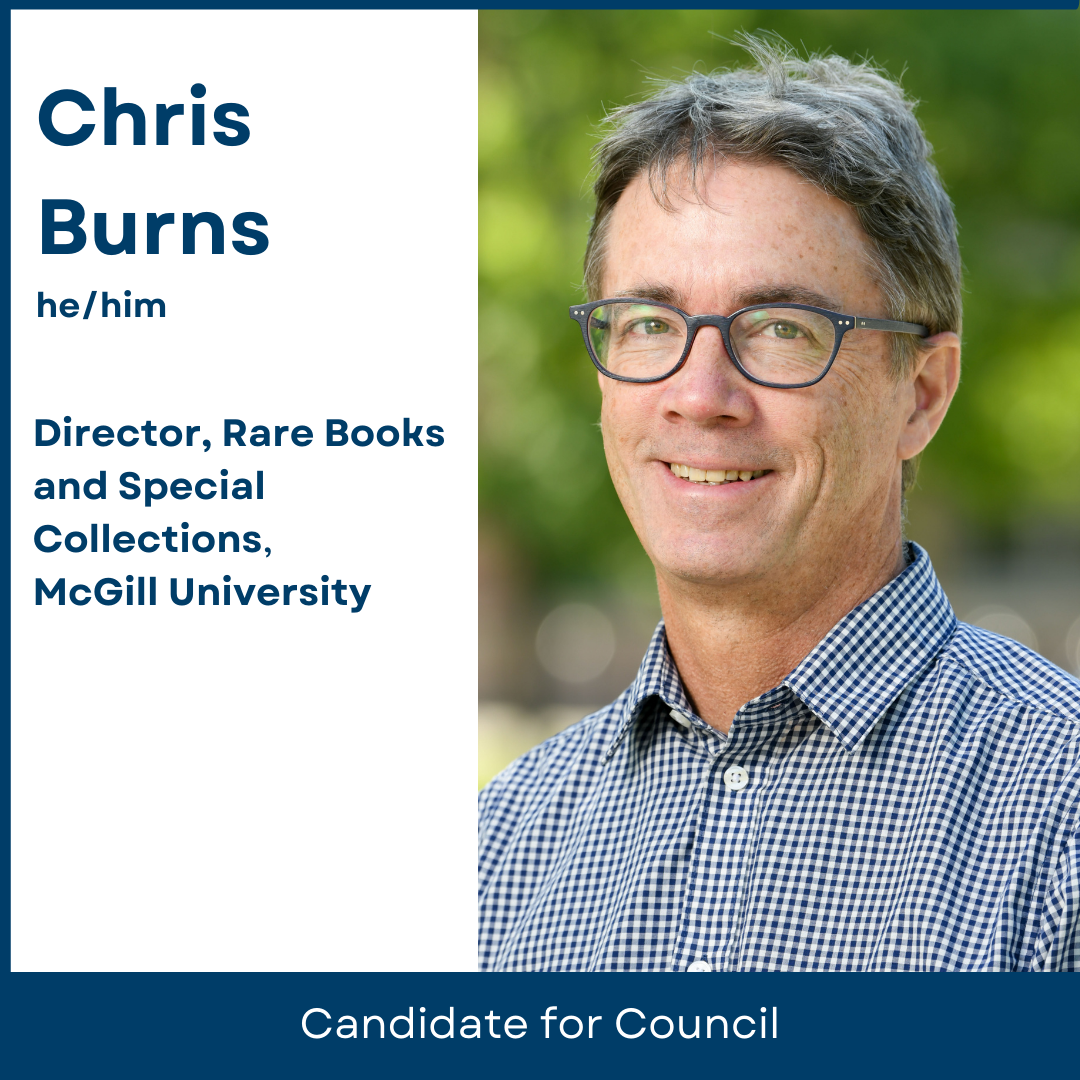
There are so many bright, talented, and engaging people doing archival work. SAA is a place where we find community with one another and, as a member of Council, I would be interested in working on issues related to how SAA can most effectively foster professional community.
Since January 2025, I have served as Director, Rare Books and Special Collections at McGill University. Prior to that, I spent most of my 25 plus years in the profession at the Silver Special Collections Library at the University of Vermont.
A member of the 2014 cohort of the Archives Leadership Institute, I have served as president of the University of Vermont Faculty Senate, as president of New England Archivists, and as chair of several SAA committees. As chair of the Manuscript Repositories Section, I led the effort to create the Jump In initiative, which provided a pathway for archivists to begin to manage born-digital records. During my time as chair of the Committee on Public Awareness, we undertook several initiatives that helped launch this relatively new committee, including a cross-over with the Archives-In-Context podcast where I and a fellow COPA member served as two of the co-hosts. I am especially proud of COPA's work on storytelling (workshops with Micaela Blei and Finding Aid to My Soul storytelling events), an initiative that I proposed and led in its first years, and that I continue to assist with. I have learned a tremendous amount in these roles, interacted with a wide variety of individuals, sharpened my skills as a leader, and served during times of great change and uncertainty. I have learned how to better define, advance, and ultimately collaborate with others on ideas of my own as well as how to best support and help shape the ideas of others. I have a demonstrated record of achievement within and outside of SAA and feel that I am well prepared for this role. I am a creative problem solver and I listen well. My approach to this work would center creativity, inclusivity, collaboration, and pragmatism.
CANDIDATE'S RESPONSE
Fostering healthy, balanced conversations begins with planning. Who is invited into the conversation, how the conversation is structured, and the mode of communication (virtual meeting, in-person, e-mails, text, etc.) are just some of the variables that need to be considered. The nature of the conversation and your role in it help determine what approaches you might take. If I'm leading the conversation, there are more opportunities to proactively think about how to ensure a diversity of voices are included, what kind of check-ins you'll use to ensure in real time that there are opportunities for everyone to contribute, and how the mode of conversation can make things harder or easier for participants. As a participant in a conversation, it's important to make sure you are not dominating the conversation yourself, to cede space to others (you'll often get the same courtesy in return), and to pay attention to non-verbal cues. It's also important to recognize that not everyone is going to feel comfortable communicating in the moment and to offer opportunities for follow-up conversations.
An example that I'm proud of stems from my time as chair of the Committee on Public Awareness. With incredible support from SAA staff, our committee undertook several new initiatives that helped this relatively new group begin to find its footing. We worked on Ask an Archivist Day, a media training workshop, a new blog ArchivesAware, an Elevator Speech graphic, a storytelling workshop and event, and a cross-over with the Archives-In-Context podcast. What we did well was everyone had a clearly defined role, there were regular check-ins, creativity was encouraged and supported, and we had the necessary resources and support from the organization to carry out those initiatives. We had an incredibly productive committee with every single member contributing at a high level. And we used multiple modes to communicate to the archives profession about issues related to public awareness, creating multiple opportunities for others to join the conversation as well.
If elected to Council, I would strive to help build an inclusive organization where a diversity of voices felt comfortable contributing to the multitude of conversations that take place within and about SAA.
CANDIDATE'S RESPONSE
Building upon some of my own service experience in SAA, I continue to be interested in how the organization can contribute to giving archivists the tools, skills, and confidence to communicate about the work we do individually and collectively (Goal 1: Advocating for Archives and Archivists from the 2023-2025 strategic plan). Having been involved in some of the past efforts in this area and having some sense of where these efforts have been successful and where there is room for improvement, I would be very interested in continuing to pursue this goal. I believe we have a strong foundation of knowledge and experience, and that the current political and financial landscape makes our advocacy and awareness efforts even more pressing.
Our advocacy and awareness work, like so much of the work at SAA, relies considerably on the efforts of SAA's component groups. Having served on multiple groups during my years in SAA, I know how much good work these groups produce and how important the relationship between Council, SAA staff, and these component groups can be. As a member of Council, I would strive to be a good intermediary between component groups and Council, encouraging them to be creative and active while working with Council to ensure the organization is able to adequately support the excellent ideas that arise from these groups.
One of the things I've enjoyed the most about my service in SAA over the years has been getting to know a really wide range of people across the organization. There are so many bright, talented, and engaging people doing archival work. SAA is a place where we find community with one another and, as a member of Council, I would be interested in working on issues related to how SAA can most effectively foster professional community. Finally, one issue that has been common throughout my years as an archivist, but is perhaps even more heightened in this current moment, is how hard it can be to find secure employment as a new archivist. It is incumbent upon SAA to continue to look at ways that it can advocate for more opportunities for new professionals and how it can continue to examine any of its own barriers to participation in the organization. I know SAA leadership and many of its members are actively engaged with these issues and I would welcome the opportunity to serve on Council and help shape SAA's role in this area as well as all of the other important issues that are facing our profession and this organization.
|
The Nominating Committee has slated the following SAA members as candidates for office in the 2026 election: Vice President/President-Elect
Council
Nominating Committee
|