- About Archives
- About SAA
- Careers
- Education
- Publications
- Advocacy
- Membership


Member associations like SAA are in a moment of transition: world economic, political, and health events have changed expectations for and abilities to engage in member associations. How we meet this transition in member-, person-focused, sustainable ways is a primary challenge for SAA.
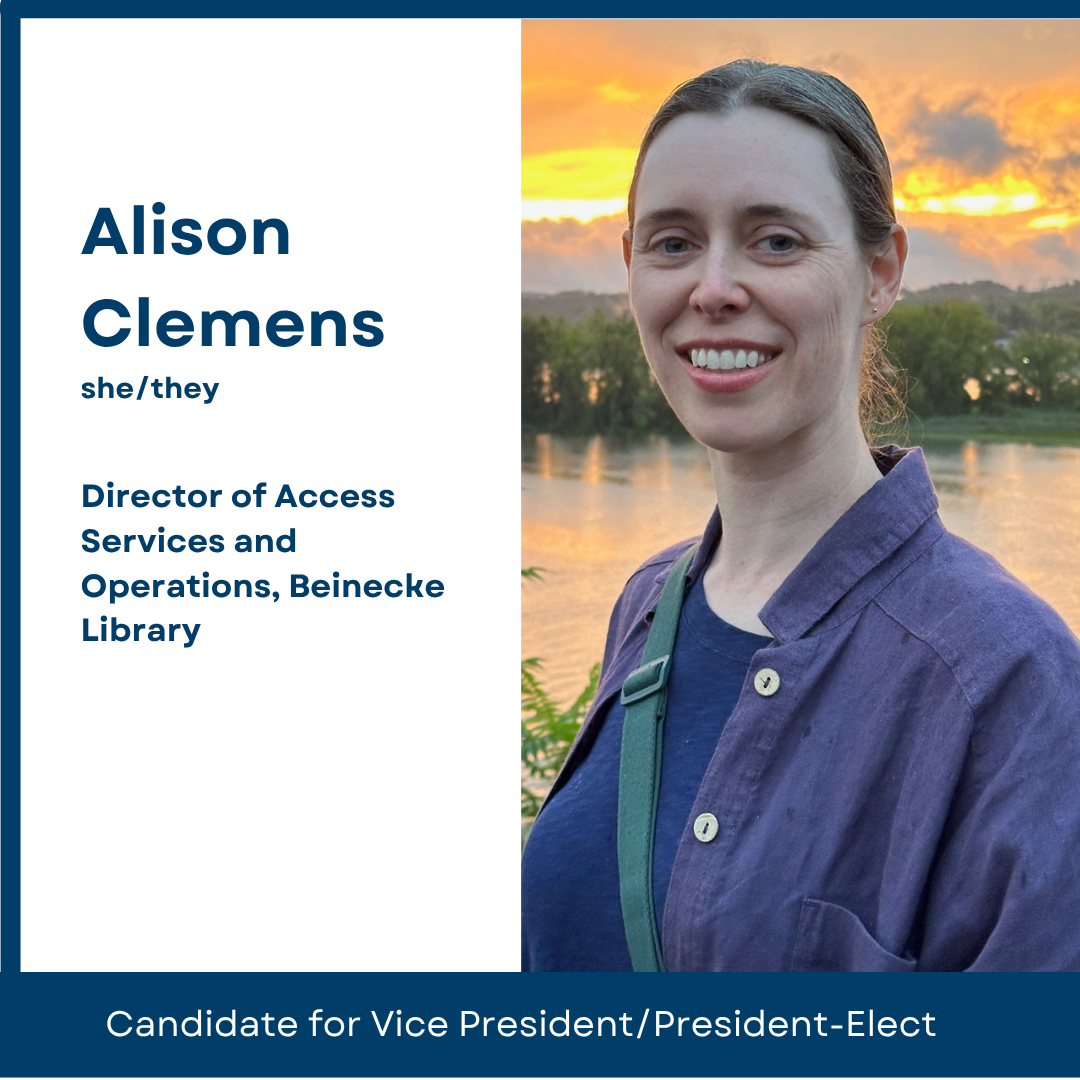
I am the Director of Access Services and Operations at Beinecke Library, part of Yale Library. I've been an archival worker since 2005 and have found practitioner communities in New England, Texas, California (my home state), and beyond. At Yale, I develop vision, strategy, and service offerings for providing seamless, equitable access to Yale Library's special collections. I'm an archivist-turned-administrator: I lead Beinecke's Access Services and Operations department, which includes reading room operations, circulation and stacks management, user assessment, reference, strategic projects, and organizational operations and development.
I love my work at Yale but see myself as an archival worker beyond institutional bounds. My career focuses include providing thoughtful, ethical, equitable access to cultural heritage; supporting archival workers; and building user-focused communities in the field. I thrive when working with others toward positive change: the greatest pleasures of my career have been convening the Abolition in Special Collections group of the Abolitionist Library Association; leading establishment of a scholarship for BIPOC students at the University of Texas iSchool; charging and serving on Yale's Reparative Archival Description Working Group; serving on the SAA Archival Workers Emergency Fund Organizing Committee; and co-establishing SAA's User Experience Section.
I've served in numerous leadership positions within SAA. I currently sit on the SAA Council, where I serve on Council's Statements Working Group and am partnering with Council colleagues to establish sustained funding for members of the Native American Archivists Section to engage with SAA (stay tuned — more on this soon!). Other personal SAA highlights include serving in chair positions on the Membership Committee, Manuscript Repositories Section, Committee on Education, and Archival History Section. I am also active in the Rare Books and Manuscripts Section (RBMS) of the American Library Association, where I served on the Diversity Committee and the RBMS Membership Committee, among other roles. Outside of SAA and RBMS, I have been actively involved in the DLF Born Digital Access Working Group and the Term Labor Best Practices Working Group, which authored the Best Practices for Archival Term Positions.
CANDIDATE'S RESPONSE
Collective leadership and building anti-oppressive facilitation strategies and practices are focuses of my professional practice. This question highlights a central challenge in group engagement and relationships. I am grateful to the colleagues who have informed my thinking on this, particularly those in the Archival Workers Emergency Fund Organizing Committee, the Abolition in Special Collections group, Yale's Reparative Archival Description Working Group, and the DLF Born Digital Access Working Group. Experience with those groups led to my co-leading an SAA Foundation Grant–funded workshop for SAA on Collective Leadership in 2024.
As a result of what I've learned and practiced in these experiences, I've come to focus on building structures in organizing spaces that strive to establish shared vision, create community agreements, structure participation avenues with clear expectations and rules of engagement, and make decision-making and conflict resolution pathways clear and transparent. Each of these focuses intend to establish trusting, open relationships in which terms of participation are clear to everyone involved.
I strive to lead with openness and honesty. When I'm facilitating a group or a conversation, I own my power as a facilitator alongside my responsibility to ensure equitable and generative contributions. If it's safe to do so, I explicitly name power dynamics and engagement differences ("I've noticed that a few of us have spoken a lot, and others haven't yet contributed. Let's make space for those who haven't spoken yet to share their perspective on this."). If the group hasn't gotten to a place where explicit interventions feel safe, I focus on building individual relationships to foster trust and understanding.
Specific strategies that I've found helpful in scenarios where certain voices are dominating are to ensure that all participants have what they need to engage in the conversation (e.g., when possible, distributing materials in advance with sufficient time to process prior to the meeting); to manage conversations using "stack"; to engage in timekeeping (as described above); and to invite everyone to speak, even if just to say "pass." Using "stack" is a virtual participation technique that allows participants to get in line to speak by typing "stack," and you can prioritize specific voices in the conversation (e.g., participants with particular marginalized identities) by asking those participants to differentiate their "stack" with an asterisk, for example.
These and other strategies can facilitate the mitigation (but not removal) of power differentials so that all group participants can contribute.
CANDIDATE'S RESPONSE
I'm currently a member of SAA Council, and we are actively engaged in creating SAA's strategic plan for 2026–2028. The questions above are big and challenging, and they're questions that extend beyond SAA. Member associations like SAA are in a moment of transition: world economic, political, and health events have changed expectations for and abilities to engage in member associations. How we meet this transition in member-, person-focused, sustainable ways is a primary challenge for SAA.
SAA needs to think — alongside its members and communities of archival workers broadly — about SAA's role, its opportunities, and what it might stop doing. My own priorities are for SAA to focus on archival workers; to build generative, relationship-focused community together; and to assert, collectively, the essential role records play in our society. We must prioritize these essential activities and consider transitioning away from activities that aren't as central to the purpose of the Society. This is hard work: it's easy to agree to stop doing things until specific activities are put on the table. I want to engage with members, SAA staff, and Council so that we can have these hard conversations together.
SAA's finances are in a challenging moment, as members know, since this has led to the recent membership dues increase. Years of deferred maintenance — something all too familiar to archivists! — led us here, and the moment we're in must be met with the seriousness, transparency, and member-informed actions. I currently serve as one of the Council members on SAA's Section Health Working Group (SHWG), and we are preparing a report and recommendations to the full Council regarding the future of SAA sections and other affinity groups. SHWG's work is informed by extensive membership input, including surveys and recent focus groups with members. I've encouraged SHWG to think big, and to think about the future — I want us to work together to imagine and build the spaces we collectively need as archival workers.
More broadly, I want SAA as an organization to continue to hear and learn from members to inform the difficult, essential, forward-looking decisions that we must make in the best interest of SAA, its members, and archival workers. I was particularly pleased to have led Council through a recent component group funding initiative, in which Council voted to set aside $5,000 for the next three years to support component group projects. Some component groups have already submitted and been approved to receive funding for amazing, member-centered projects — I'm so pleased that SAA is able to financially support their work. Initiatives like this are at the core of what SAA should be doing: they allow us to build community, and to be stronger, together.
As our colleague Terry Baxter often says, we are SAA. I believe that the United States needs this organization to continue to thrive and to lead, and that we need each other. I look forward to doing this important work together.
|
The Nominating Committee has slated the following SAA members as candidates for office in the 2026 election: Vice President/President-Elect
Council
Nominating Committee
|