- About Archives
- About SAA
- Careers
- Education
- Publications
- Advocacy
- Membership


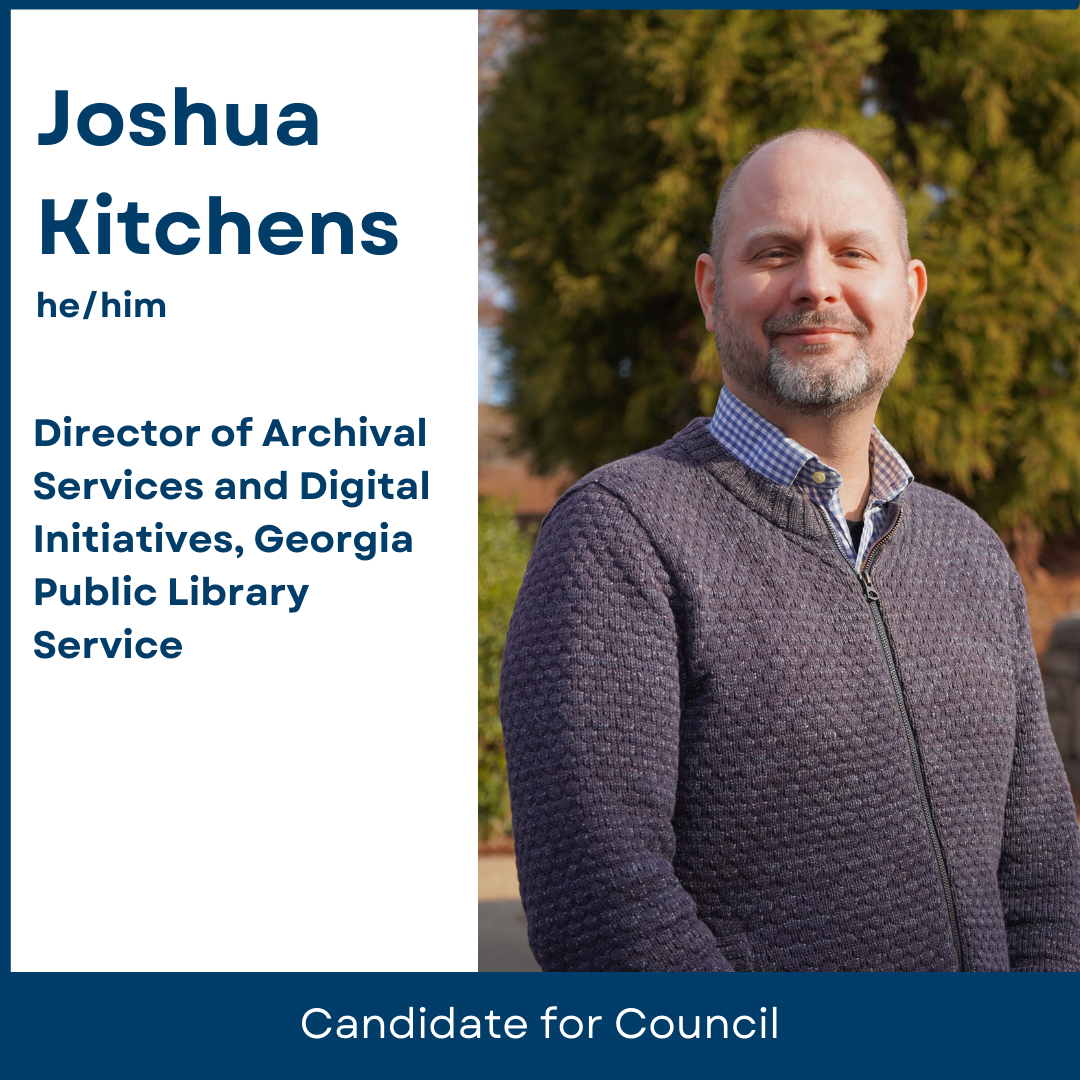
What I love most about being an archivist is listening to people and helping them preserve and share their stories.
I've always been interested in working with information. My first job was as a file clerk for the local county government. Even at 16, I liked sorting files, but what really caught my attention were the stories behind those records. That experience got me hooked. I worked in archives as a student and graduate assistant while earning my first two degrees. Since 2008, I have worked as a professional archivist and educator. My first archivist job was at Georgia College and State University, where I helped launch the Knowledge Box, the university's institutional repository, and started an oral history program focused on the university and the Milledgeville and Baldwin County community. In 2015, I became a faculty member and program director for the Master of Archival Studies at Clayton State University. There, I taught classes, updated the curriculum to reflect the different communities archives serve, and explored new technologies. Now, I am the Director of Archival Services and Digital Initiatives at Georgia Public Library Service. I get to work with public libraries and their community partners across the state, helping them share their stories through records and keep those stories local.
I have served in several roles with the Society of Georgia Archivists, including president and treasurer, and with the Academy of Certified Archivists as regent for outreach. Right now, I am chair of the appointments committee for the Society of American Archivists. For SAA, I have written and edited for the Electronic Records Round Table and taught courses on topics like copyright and digital forensics. I really enjoy helping archivists across the US share ideas and learn from each other.
What I love most about being an archivist is listening to people and helping them preserve and share their stories.
CANDIDATE'S RESPONSE
My approach to acknowledging diversity issues is not to speak, but instead to listen. My understanding of diversity, equity, and inclusion is not shaped solely by my experience, but through listening to other voices, specifically those that are often silenced. I recognized that I have a perspective and a voice, but I can not help but focus first on listening. Therefore, for someone from a privileged background, I need to listen and facilitate. Listening does not only involve hearing people's concerns, issues, and points, but also taking action to ensure those points are shaping decisions, stories, and policies. Listening requires action. Facilitating diverse conversations means decentering myself as a person who may be "in charge" and focusing on creating an environment where everyone can speak. This can mean that I sometimes have to ask the loud people to step back and kindly help them understand that it is someone else's turn to talk.
Throughout my career as an archivist, I have sought to center others' voices and perspectives in my work. Whether this is being the interviewer during an oral history interview, and ensuring there is space for the narrator to tell their story. Or in a professional organization, where I believe there is a moral obligation to celebrate all of my colleagues' work and successes, and to ensure that many different voices can be heard through committee appointments, nominations, or simply taking time to listen when someone has a concern.
For example, through my work with public libraries in Georgia, I have learned how valuable African American funeral programs are as a resource for genealogists, local historians, and the communities they represent. This record is not a source that some might consider valuable, but through my work with public libraries, I have had the good fortune to understand how precious they are. As an archivist, I need to listen to the libraries that have collected them, the communities that interact with them, and the programs themselves. When I can hear what stories they are telling, I can relate those stories and their meaning to others. A record, like a funeral program, tells us who a person was and their importance to their family and community. My job is to tell others what I have heard, and to help them listen as I have. Diversity, equity, and inclusion start with listening.
CANDIDATE'S RESPONSE
SAA needs to listen to its members, especially when they are upset about decisions being made. If SAA is not reaching all types of archivists from diverse experiential and financial backgrounds, then SAA is not living up to its core organizational values. These types of conversations will be difficult, but I am willing to listen and facilitate them. My goal on council is to be open, transparent, and more importantly, available to all SAA members who need and want to be heard.
My priorities on Council include:
Advocating for Archives and Archivists
On council, I plan to work on finding ways that SAA can support our membership and our profession in extremely challenging times. Not only is there financial uncertainty, but also social and political uncertainty. We, as archivists, need to come together to survive the current state that we are in. I vow to ensure that SAA engages in conversations not only with archivists but also with our stakeholders and funders to explain the importance of open, diverse, accessible, and authentic archives. This will, at times, require strong, aggressive language from SAA, and at others, negotiation and strategic communication to protect, promote, and advance our profession. I will bring my experience as SGA president, collaborating with colleagues in the Georgia Library Association and the Georgia Media Association, to oppose SB 390, which sought to prohibit state participation in ALA. Georgia libraries and our supporters successfully advocated against this harmful bill.
Financial Transparency
I have previous experience serving as treasurer for two organizations: the Society of Georgia Archivists and Friends of Georgia Archives. Each time I have been a treasurer, I have been brutally honest about the financial health of each organization, and when I think expenditures were concerning and problematic. This is my pledge to the SAA membership: I will explain in detail the financial issues at play for SAA, the rationale for the decisions being made, and the concerns I have about any financial issues facing the society. I also pledge to seek opportunities to increase the value of SAA membership and make it more accessible to more archivists, regardless of employment status.
Advancing the Field
I am an educator at my core. I love helping spread knowledge about the field of archives. If elected to the council, I would like to find new ways to foster the exchange of ideas, skills, and best practices throughout SAA. To me, nothing is more important than providing a space where archivists can share their knowledge and wisdom about the field. I've demonstrated this as an educator who always seeks new ways to teach, whether through formalized training programs or spontaneous one-on-one discussions about archives. At GPLS, I have to find ways to meet our public librarians who are interested in archives, where they are, which often means taking time to visit and walk through archival topics and best practices in small groups or one-on-one.
|
The Nominating Committee has slated the following SAA members as candidates for office in the 2026 election: Vice President/President-Elect
Council
Nominating Committee
|