- About Archives
- About SAA
- Careers
- Education
- Publications
- Advocacy
- Membership


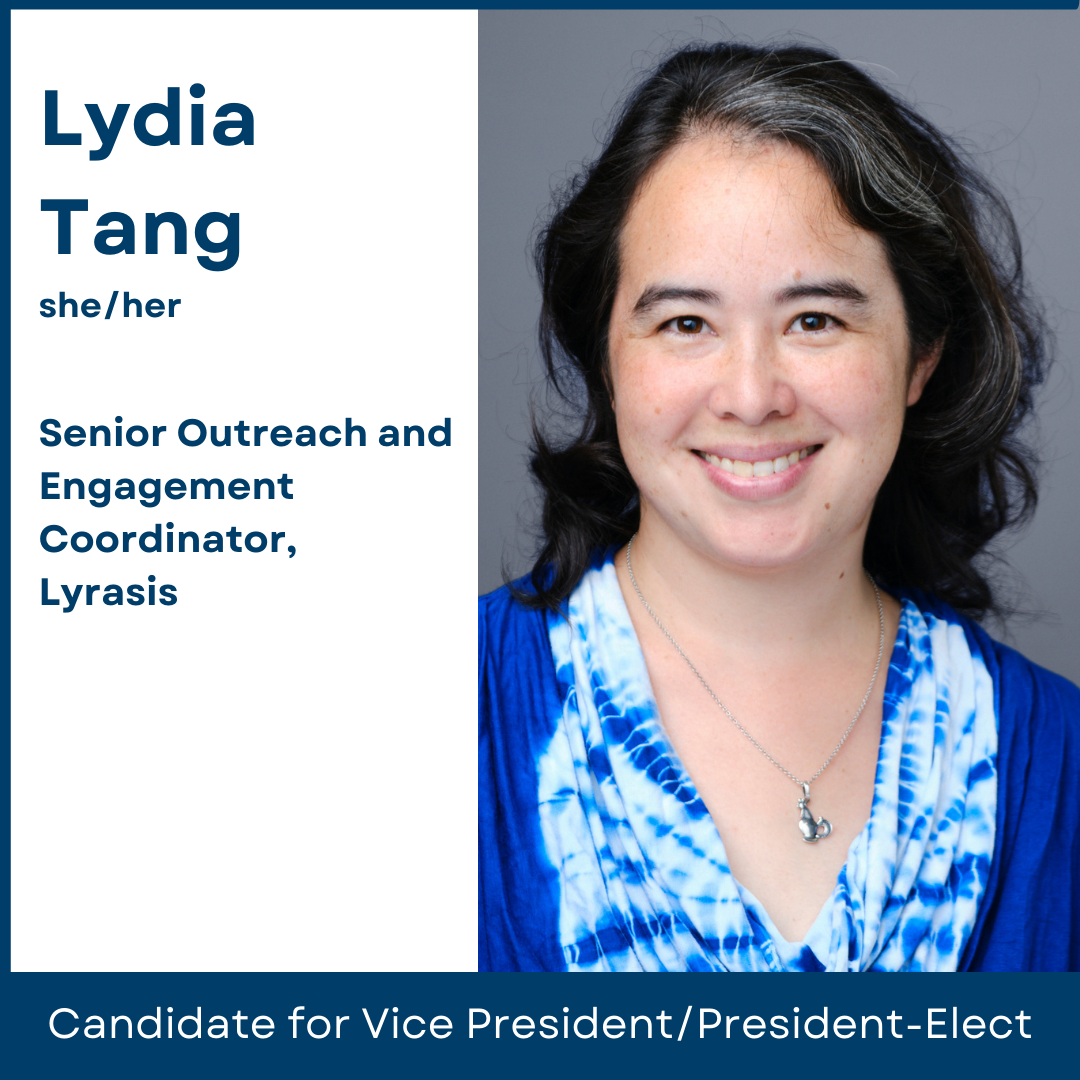
I am a systems thinker and an architect of ideas. I thrive on connecting people and building community resources. [...] From archival practice to accessibility to technology to organizational sustainability, I bring the range of capabilities SAA's leadership requires. I'm running to build systems that support our profession and each other.
I am a Senior Outreach and Engagement Coordinator at Lyrasis, where I provide leadership for the ArchivesSpace hosting program and advance accessibility across the organization. Previously, I held positions at Michigan State University, the Library of Congress, and the University of Illinois, where I earned my MLIS and Doctor of Musical Arts degrees. I am the 2020 recipient of SAA's Mark A. Greene Emerging Leader Award and a Certified Archivist. I am a systems thinker and an architect of ideas. I thrive on connecting people and building community resources. At SAA, I have held leadership positions in multiple sections, including founding the Accessibility & Disability Section. During the pandemic, I co-chaired the Mentoring Subcommittee, steering it through major infrastructure upgrades and flexing the program to meet acute mentoring needs. As repositories closed, I partnered with colleagues nationwide to spearhead the "Archivists at Home" collaborative document and co-found the Archival Workers Emergency Fund.
Throughout my career, I have centered accessibility within the profession. As a CPACC-certified accessibility professional and Department of Homeland Security Section 508 Trusted Tester, I served on both revisions of the Guidelines for Accessible Archives for People with Disabilities, have keynoted at multiple conferences, teach accessibility courses through Lyrasis Learning, and advance accessibility in the tools we use (ArchivesSpace, CollectionSpace, and DSpace). I co-edited "Preserving Disability: Disability and the Archival Profession" (Litwin Books, 2024) with Dr. Gracen Brilmyer.
As a certified Project Management Professional (PMP) and through my service on Council (2022-2025), I understand the business side of nonprofit work—budget analysis, revenue generation, vendor partnerships, and assessing people, processes, and systems to meet our needs. From archival practice to accessibility to technology to organizational sustainability, I bring the range of capabilities SAA's leadership requires. I'm running to build systems that support our profession and each other.
CANDIDATE'S RESPONSE
I approach this question through the lens of accessibility, which has been central to my professional identity and practice. Creating equitable spaces means recognizing that people engage differently—some voice ideas immediately while others need time to process, some face greater risk when speaking up, and some voices are heard and respected while others are glossed over because of societal bias. Inclusion requires intentional design, not just good intentions.
As someone with multiple, often contradictory societal identities, I understand firsthand how systemic barriers operate and how different facets of identity make navigating spaces both easier and more difficult depending on context. This lived experience shapes my commitment to removing obstacles that prevent participation. When I co-founded SAA's Accessibility & Disability Section and co-chaired the task force to revise the Guidelines for Accessible Archives for People with Disabilities, I learned that centering marginalized voices in decision-making—not just accommodating them as an afterthought—is what creates meaningful change.
As I've moved into progressively more visible leadership positions, I've grown increasingly aware of how one's mere presence can impact a conversation. The CEO of my organization wears red Converse sneakers and, while I haven't transitioned to such bold fashion statements, I appreciate the lesson about approachability. I work to avoid being the loudest voice or always speaking first. I'm also mindful of not giving the "stamp of approval" or final judgment by speaking last, which can shut down further discussion.
In practice, I ensure inclusive participation through multiple channels. I actively manage discussion flow by taking stack, being mindful of time, ensuring everyone has the chance to speak, and observing hesitations and pregnant pauses. I build in asynchronous feedback mechanisms—recorded meetings with note-taking, anonymous input forms—because not everyone is able to or should have to advocate for themselves in real-time. I practice transparency in decision-making so people understand how their input shaped outcomes. I often draw upon AORTA's anti-oppressive facilitation principles, which I first encountered at an SAA meeting: "one diva, one mic," "step forward, step back," and "together, we know a lot." These simple phrases remind me that inclusive leadership isn't about having all the answers or even actively "leading," but about fostering thoughtful, trusting, and creative dialogue to help us build our ideas—together.
CANDIDATE'S RESPONSE
We, the members, are SAA. We gather to share information, build tools, and support each other. Within our 90-year-old institution, we carry a proud legacy that can also be unwieldy. Can we meet membership needs while creatively flexing how we do things?
Managing competing priorities requires honest assessment of costs versus value. The hybrid conference expands access but nearly doubles costs which are passed to members. What if, instead, we transform the Research Forum into a fully remote symposium six months from the in-person conference, creating two distinct venues to engage with?
SAA's budget challenges are not secret. As someone who analyzes budgets and revenue streams, I would examine our finances closely. Since membership dues comprise the majority of revenue, it would seem logical to increase dues. However, we are facing a professional crisis: political turmoil, workforce reductions, and shrinking budgets. Like guilds, we highly trained specialists need an organization for support and strength—but when that organization extracts more from us, we lose members entirely.
Near the conclusion of my Council term, I proposed updates to SAA's institutional membership structure. Drawing on models like the Digital Library Federation, where organizational memberships sustain operations while individuals freely participate, I proposed updated dues structures with correspondingly greater discounts and benefits to encourage institutional membership adoption. I would also explore closer partnerships with allied organizations for shared infrastructure and cost-sharing and encourage membership discounts with partner vendors.
SAA runs on member expertise, time, and passion. I want SAA to embrace a co-op ethos—the energy of Auctions4AWE Fund and the Mentoring Program. Yet our "pay to play" reputation undermines this. While we cannot pay members for volunteer service, we must demonstrate sincere appreciation with discounts, resources, support. SAA also needs to "manage up" to employers, advocating for membership ROI.
Archivists are often misunderstood and undervalued in our organizations and society. We need to continue A*Census data collecting and reporting and external advocacy efforts. I would welcome local stakeholders to our annual meetings as day-pass guests and scale Archives on the Hill's advocacy model to happen strategically at each meeting location, not just every four years in Washington. Every bridge we build is a chance to change hearts and minds.
Our Society struggles with scope: who is an archivist and who belongs? Members who find roles outside the established path may wonder if they fit. I would create cross-pollinating conversations with allied fields—genealogy, knowledge management, records managers, museum workers, digital humanities practitioners, archival producers—so our members see synergies and broaden their professional horizons.
When the Nominating Committee reached out, I weighed this decision carefully. This is a challenging time, politically and professionally. I'm stepping forward because I care deeply about supporting this profession and my colleagues. I bring transparency, systems thinking, and collaborative leadership grounded in accessibility practice. I understand that inclusion requires intentional design. I commit to active listening, to interrogating structures that no longer serve us, and build systems that support support each other through change.
|
The Nominating Committee has slated the following SAA members as candidates for office in the 2026 election: Vice President/President-Elect
Council
Nominating Committee
|