- About Archives
- About SAA
- Careers
- Education
- Publications
- Advocacy
- Membership


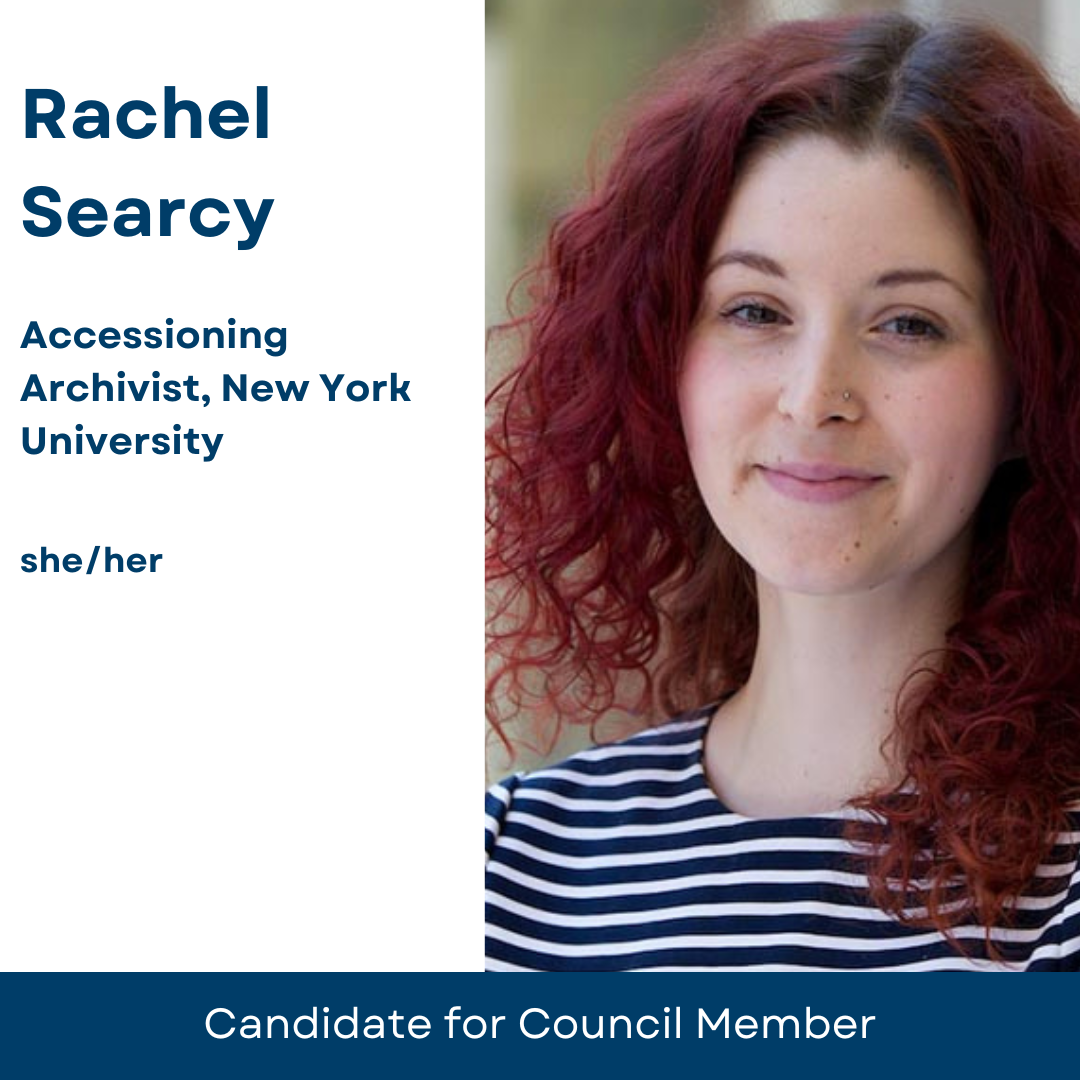
"I spent much of my early working life in food service, and I took great pride in my side-work - doing the little things that make life easier for yourself and your colleagues. I have carried that through my career, focusing on sustainable processes that move towards a horizon through tending to the details."
I entered the field in the wake of "More Product, Less Process," when backlogs dominated conversations. I also began my career in the Great Recession, and spent my first seven years in contingent roles carrying significant student loan debt. These experiences shaped how I understand archival labor, and crystallized the importance of supporting archivists' lives and careers. I am thankful for those responsible for shifting the tide to add nuance to these conversations, surface critical issues, and increasingly support archival workers' wellbeing. I am and hope to always be a practitioner. The bulk of my job is the in-the-weeds work of accessioning collections: I carry heavy boxes, encounter mold, get so many papercuts, look up names and subjects in authority files and controlled vocabularies, and draft and rewrite archival description. Working in the "back of house," to borrow a term from my food service days, has given me invaluable experience at the intersection of work that is both critical and also undervalued or misunderstood. At many times, I have found myself in situations where maintenance had been deferred, requiring rebuilding by others. And in so many conversations with others in the field, I know I am not unique in this regard. These are opportunities to build stronger foundations and adjust our systems, documentation, workflows, and collaborations to serve us better. I spent much of my early working life in food service, and I always took great pride in keeping up with my side-work – rolling silverware, refilling salt and pepper, and re-stocking the server station – doing the little things before they turn into emergencies, and finding ways to make life easier for yourself and your colleagues. I have carried that through my career, focusing on sustainable processes that move us towards a horizon through tending to the details.
(Each candidate prepared a diversity statement according to SAA guidelines.)
We are in a moment of great precarity and division. The issues of the profession mirror those of society more widely: wealth inequality, political polarization, bad faith arguments and misinformation, and a climate crisis that threatens our very existence. Diversity, inclusion, and belonging cannot be achieved through acronyms or platitudes, but must be a daily practice we all make our responsibility. Part of my daily practice is to consistently approach my work with a critical lens, and embed anti-oppressive practices in our workflows. I have operationalized reparative description as a routine part of our accessioning workflow, viewing every accretion to an existing collection as a chance to revisit legacy description. I have led multiple reparative description projects, implemented alternative vocabularies, collaborated with my colleagues to update our internal documentation to address positionality, and encouraged those I supervise to identify gaps in the record, approach appraisal decisions with empathy, and to document collections accurately, respectfully, and expansively. I regularly collaborate with curators and collection creators on description to ensure accurate and respectful identity terms, and share power with those with more expertise. Some examples include: collaboratively selecting Homosaurus headings with members of a queer and trans creator organization, sharing authorship of description with creators of a podcast on the Vietnamese diaspora, consulting with researchers on the experiences of incarcerated individuals on archival description and subject headings, and creating records in the Library of Congress Name Authority File for under-represented collection creators. The further I am in my career, the more comfortable I am admitting what I don't know. As someone with multiple privileged identities, I take responsibility for filling the gaps in my understanding and identifying (and interrogating) my own biases. I also find great comfort in frameworks like cultural humility, which empower me to support those who know more than I do. Over the past few years, I have initiated and co-facilitated cross-departmental discussion groups on works like Urgent Archives and Decolonial Archival Futures, and have tried to make space for diverse perspectives to engage with challenging concepts and emerge with concrete possibilities to pursue. As I increasingly focus on my relationships with others, I seek to be a respectful and generous partner, to approach points of confusion or disagreement with genuine curiosity and open-mindedness, and to leave every professional space better than how I found it.
How would you manage competing priorities for financial stability and meeting membership needs? What specific measures do you plan to pursue to guide the Society in alignment with its mission and strategic goals? What qualities and values would you bring to this role to ensure equitable and responsive governance of the Society?
CANDIDATE'S RESPONSE
If I am lucky enough to be elected to Council, I specifically intend to focus on ways to empower practitioners, support varied pathways for professional growth, and continue to support and uplift the incredible research, standards, and best practices work being conducted in the field. That these items are already identified in the 2023-2025 Strategic Plan shows the prescience and ambition of our organization. Enhancing Professional Growth (Goal 2 of the Strategic Plan) is inextricable from Recruitment and Retention (Goal 1 of the DEIA Work Plan). Addressing contingent labor, supporting BIPOC workers in material ways, and advocating for workplace protections go hand-in-hand with growth opportunities, enriching the historical record, and staying relevant in times of change. While working on developing the Archival Accessioning Best Practices, I oversaw the creation of a section called "Successful Accessioning Labor Practices," which provides concrete suggestions for archivists to advocate for themselves, as well as ways managers can better support those they supervise. Our decision to address labor issues alongside archival activities like description and preservation was a deliberate choice to not separate the work from the worker. Too often these conversations are siloed, and I will endeavor to help forge more connections. As one of the co-editors of an upcoming special section of American Archivist, I worked with my co-editors to make space for and provide support to first time authors, students, and practitioners who might not have the same support for writing as high-level administrators or archivists at research institutions. There are so many talented individuals in our organization with powerful perspectives and meaningful insights; unfortunately many do not have the time, energy, or institutional support to share their wisdom or participate in professional service. I'd like to explore additional ways to make space for these voices in our field, and to give them the platform and recognition they deserve. A rising tide lifts all boats. I also hope to focus on the areas devoted to Advancing the Field (Strategic Plan Goal 3), particularly the places that intersect with the DEIA Work Plan regarding antiracism, labor and workplace protections, and the climate crisis. I would like to support the work of the many SAA entities who have been working towards these outcomes, and help facilitate connections between these groups (when appropriate) to strengthen efforts and share the load. I am continually impressed by the time, energy, and care members give to SAA, from standards creation and maintenance, to educational programming, to section leadership, to public policy advocacy, to original research. If elected, I am committed to recognizing and supporting this work to the best of my abilities.
The Nominating Committee has slated the following SAA members as candidates for office in the 2025 election: