- About Archives
- About SAA
- Careers
- Education
- Publications
- Advocacy
- Membership


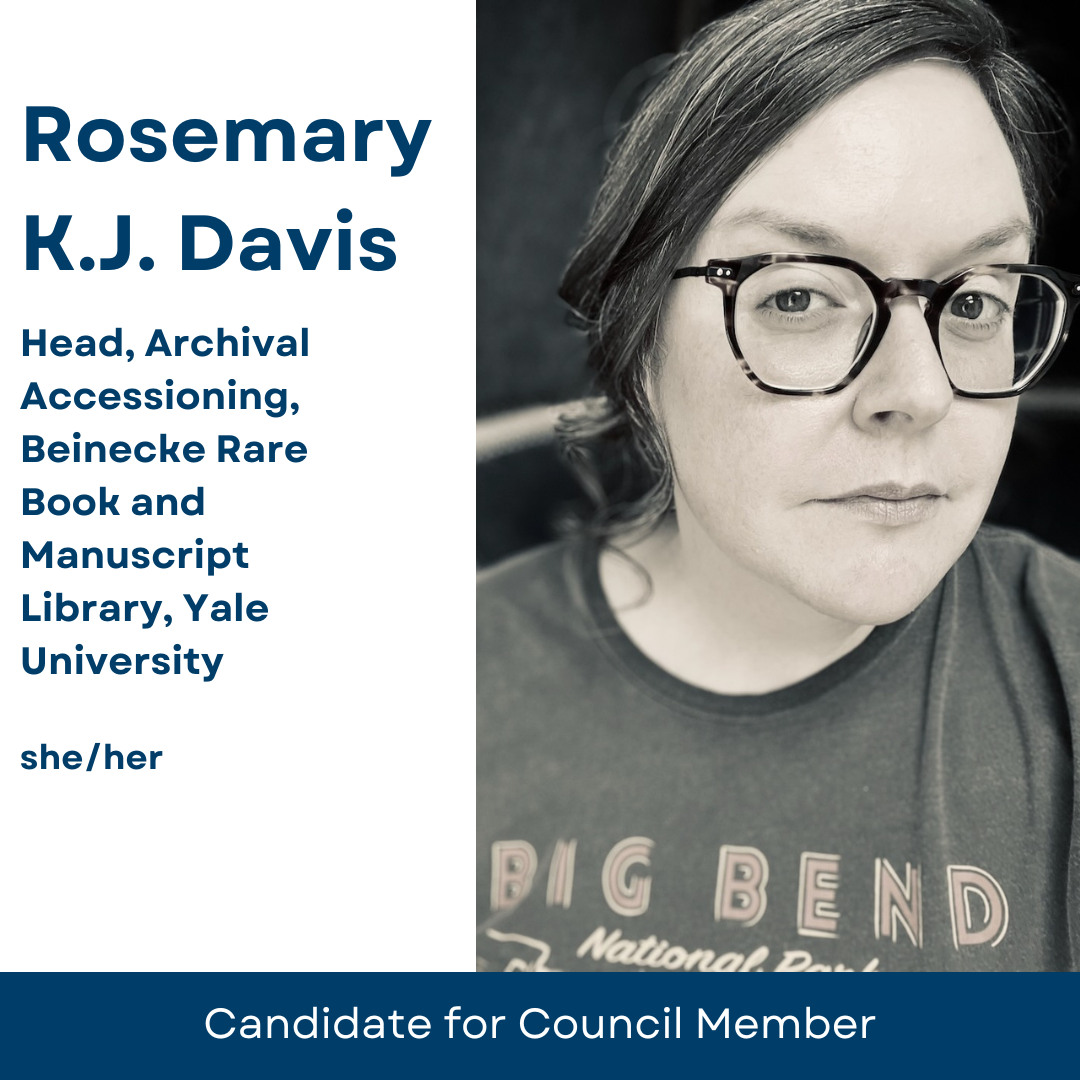
"Truthfully, more than anything, rooting my archival work in meaningful relationships has proven to be transformative."
I have been
an archivist for fourteen years. In 2016, I landed at Yale University's
Beinecke Rare Book and Manuscript Library, where I’ve worked with the library's
Archival Accessioning team: first in the role of Accessioning Archivist and
then as Head of the team for the past 2.5 years. This is the only
non-contingent employment I have held since entering the field. It was odd and
humbling when I realized awhile back that I had officially passed the threshold
of being employed in one place longer than any other in my life.
Project archivist work fueled (and depleted) my first half decade in the
profession, even though I acquired important skills and grew as an archival
practitioner. Those years continue to kindle my interest in ethical and
inclusive labor practices. Beyond that, project archivist gigs are where I
started to really love archival description not just for the fact of it, but
for the possibility of it. Accessioning work widened my perspectives; it
gave me strength-training in applying relationship-building as a professional
lens. Truthfully, more than anything, rooting my archival work in meaningful
relationships has proven to be transformative.
My past SAA service roles have been primarily rooted in archival ethics,
labor visibility, and building communities of practice. As a member of the
Committee on Ethics and Professional Conduct, I collaborated on the revisions
for the most recent version of SAA's Core Values Statement and Code of Ethics.
As a member (and eventual Chair) of the SAA Accessioning, Acquisitions, and
Appraisal Section, I successfully advocated for formal recognition of
accessioning in the section's scope.
And, most meaningfully to me, I served as co-founder of a thirty-two person working group that produced the first set of SAA-approved National Best Practices for Archival Accessioning in the United States. This project created connections and resources that now feel fundamental instead of impossible. I am grateful for the way that group and its work helped me reaffirm my commitment to serving as an advocate for archival labor and for the individuals who perform it.
(Each candidate prepared a diversity statement according to SAA guidelines.)
I try to be an empathetic and respectful contributor to the fields of archives and special collections. Recognizing and understanding my own positionality–white, cis, hetero, non-contingently employed at a PWI academic institution–drives me to approach my professional work and service with a sense of cultural humility.
Our roles as archival workers exist to help safeguard diverse cultural histories, to support robust access to materials we steward, and to build relationships with the individuals and communities whose collections we help maintain. Special collections environments can evoke feelings of exclusion and intimidation for many. The role of an archivist--as mediator, as physical protector, as steward—is often fraught. Accordingly, an archivist must be attuned to the needs of collections, to the needs of communities who use these archives, and to the dignity of the people whose histories we steward and support.
But we must also be attuned to the needs of our comrades in this profession. Much of my own service organization engagement has been in support of making the labor and needs of archival workers more visible. Throughout my career, I’ve sought out opportunities that allow me to generate protective, inclusive, and/or more expansive space for others:
–As part of the National Best Practices for Archival Accessioning Working Group, I contributed to both the Guiding Principles Subgroup + the Labor, Ethics, Relationships, and Work Environment Subgroup.
–Working with the New England Archivists Inclusion and Diversity Committee, I assisted with code of conduct revisions, supported the expansion of the committee itself, advocated for salary requirements in job postings, and contributed to the creation an anti-racist and anti-oppressive readings resource.
–As a mentor—both informally and through programs facilitated by SAA and New England Archivists–I’ve worked with members of my local professional community, with first-year students at Yale University, and with colleagues in the broader archives/special collections fields.
–During my tenure as Managing Editor for the Journal for Contemporary Archival Studies (2019-2025), I helped foster more geographic diversity within the editorial board, advocated for increased financial support, and facilitated stewardship for dozens of scholarly articles.
I see the opportunity to serve on Council as an extension of my dedication to identify opportunities where SAA can do more to support its members as their needs grow and evolve during these uncertain times.
How would you manage competing priorities for financial stability and meeting membership needs? What specific measures do you plan to pursue to guide the Society in alignment with its mission and strategic goals? What qualities and values would you bring to this role to ensure equitable and responsive governance of the Society?
CANDIDATE'S RESPONSE
For SAA to function as a vital and trusted organization, it needs to make good on its promises to provide meaningful support to its membership through advocacy, resources, and community-building. There are great tensions related to the costliness of professional participation for many members. Simultaneously, the intensifying financial needs of maintaining an organization of SAA's magnitude are enormously complex.
But still: there are no unfraught ways to request uncompensated volunteer labor, while also requiring a paid membership to perform that labor. There are no uncomplicated methods to keep a professional organization thriving in a world where the destructive impacts of climate change, transphobia, white supremacy, mass incarceration, and extractive capitalism are on full display. That said, I do believe SAA can help its membership build solidarity by providing continued opportunities for collective mobilization and individual progress.
As a Council member,
I would be particularly interested in contributing to strategic priorities and
projects including:
Labor ethics: advocating for more comprehensive salary reporting and inclusive
job description. (DEIA Work Plan - 1.1); examining contingent labor and
pathways to a secure career for BIPOC, LGBTQIA+, and disabled archival workers
(DEIA Work Plan - 1.2)
The environment and sustainability: supporting continued work to document and discuss climate change's impact on archival work and environments
Professional growth and education: supporting development of forums focused on the future of the archives profession; further development of mentoring tracks for both practitioners and managers; contributing to ongoing review of SAA's educational offerings to update and expand options that reflect current topics and expressed needs from the org's membership (DEIA Work Plan - 3.1)
Seeing the needs of members reflected in the tangible actions of the org's leadership is extremely meaningful—to feel seen, to have access to tools and resources, to be moved forward by a collective commons working for positive outcomes. I'd be honored to put my efforts towards support of the issues above, as well as others the SAA membership might deem as priorities. I believe in our strength, even in times such as this.
The Nominating Committee has slated the following SAA members as candidates for office in the 2025 election: