- About Archives
- About SAA
- Careers
- Education
- Publications
- Advocacy
- Membership


"Our professional associations depend on the generosity of people's time and capacity. With honest conversations and transparency, Nominating Committee members can explain the full scope of the service so that with knowledge of the role and the difference it can make in the profession, can empower members to volunteer."
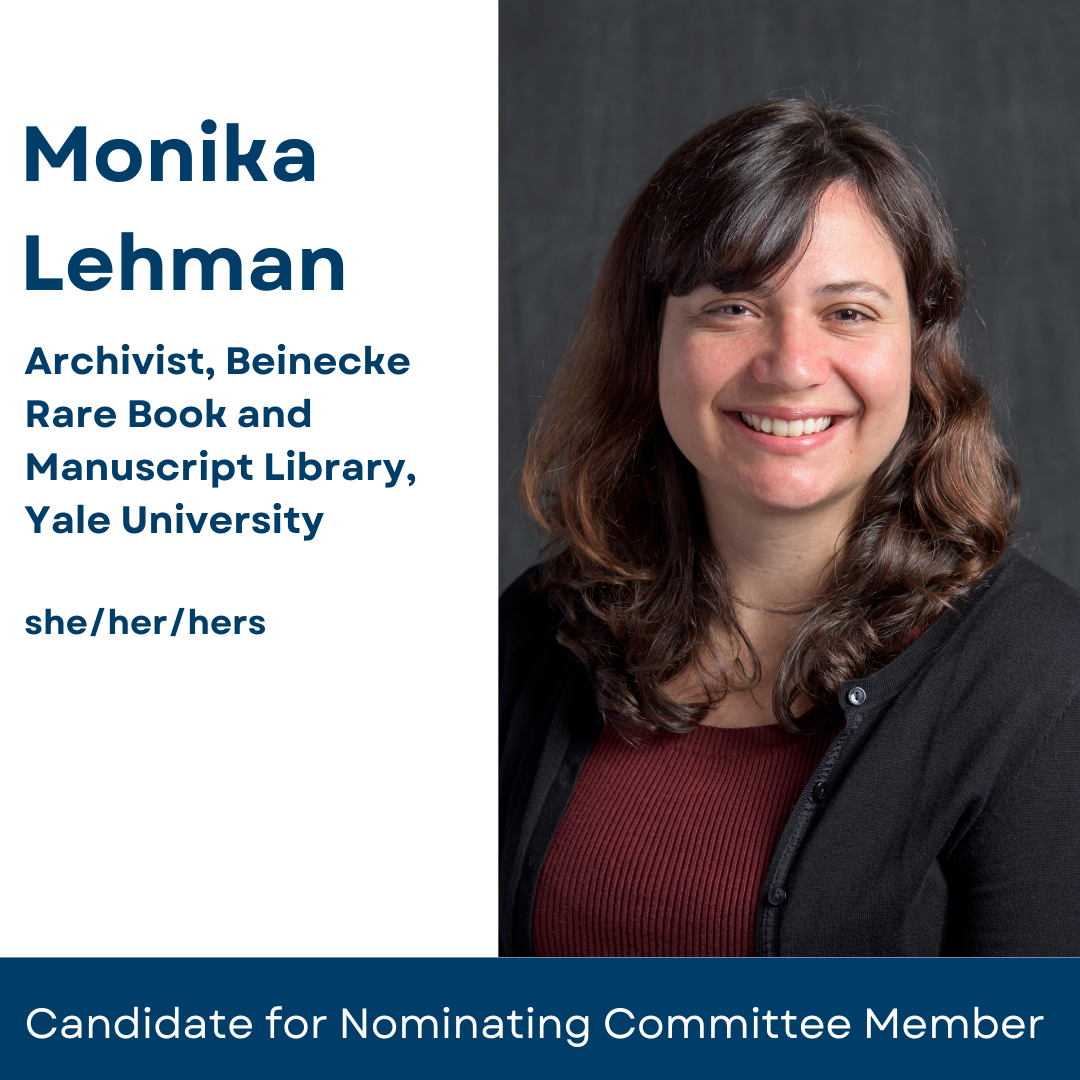
Monika Lehman is an archivist at the Beinecke Rare Book and Manuscript Library. Prior to her current position, she worked as a project archivist at the Beinecke for two years; this experience informed her perspective while serving as a member of the Working Group on Term Labor Best Practices. She has worked to promote this work through a panel presentation at RBMS in 2022. In 2023, this group's Best Practices for Archival Term Positions was approved as an external standard by SAA Council. Building on this standard, Monika co-authored a publication for the CLIR Pocket Burgundy series entitled: Creating Ethical Term Positions in Archives. Since 2021, Monika has been a member of the Yale Reparative Archival Description Working Group, stepping into the role of co-chair in 2023. With the Journal of Contemporary Archival Studies, Monika has served as a peer reviewer, book review editor, and associate editor; in March 2025, she begins a three-year term as Managing Editor. Monika previously served on the New England Archivists' Inclusion and Diversity Committee from 2020 to 2022, the SAA editorial board from 2019-2023, and on SAA's mentoring subcommittee from 2021-2022. Monika has served as a SAA mentor and currently volunteers as a SAA Career Counselor.
(Each candidate prepared a diversity statement according to SAA guidelines.)
Diversity is what makes individuals special, and those perspectives help us continuously develop a rich social tapestry of lived experiences. Equity is giving everyone the same opportunities, the same chances for success, along with equal access to resources that will help them address challenges. Inclusion means that all are welcomed and appreciated for their diverse skills and viewpoints. I think that making sure the nominating committee has a slate of diverse candidates is essential for SAA's success. While I was in a project position, I was lucky to have a supervisor who advocated for me to be treated like every other archivist on staff, even though my position was temporary. She encouraged me to participate in committees, take advantage of professional development opportunities, and to learn and grow during my term. It made a profound impact on me as an entry level archivist and made me rethink what project positions could be: a point where both the institution and the individual benefit rather than just the institution benefiting. This has informed my work in mentorship, career counseling, and with students.
Being included and having the same opportunities as those in permanent positions, made me want to stay in this profession and is a reason why I have stayed professionally involved. I am aware of my implicit biases, but I feel like I am always learning as I move forward through this work.
I have found that I do not always know how I feel about things until I encounter them directly. If I find a bias unexpectedly showing up, I take a step back and work to educate myself. I approach my work with cultural humility. Through my work with Yale's Reparative Archival Description Working Group, I also encounter materials that cause harm. I make sure to let fellow group members know that we are charged with challenging work to take care, take breaks, and talk with one another on how the work affects us. Our professional associations depend on the generosity of people's time and capacity. With honest conversations and transparency, Nominating Committee members can explain the full scope of the service so that with knowledge of the role and the difference it can make in the profession, can empower members to volunteer. We can identify gaps in our representation in positions across SAA and reach into our networks and beyond to give space for a diversity of voices.
The Nominating Committee plays a crucial role in shaping the elected leadership of SAA. Share your strategies for inspiring members to participate in running for leadership positions and engaging in the election process. How will you ensure a slate of candidates that support an awareness of the role of power, positionality, inclusion, and belonging in our Society?
CANDIDATE'S RESPONSE
In my experience, the more a potential volunteer can learn about a role--its time commitment and its impact--from someone who has been in that position, the more that person can feel empowered to take on that role by having a deep understanding of it beforehand. In my own volunteer service, I have felt the most confident to participate when I have been able to speak to someone who understands what a role entails and can tell me about their own lived experience of the work needed. Ways to foster interest and understanding with volunteers include: one on one conversations, information sessions on Zoom to answer questions, and asking currently-serving volunteers to write about their experiences. Making that information and context available can both help us reflect on what we are asking of our volunteers, and in return help our volunteers make an informed decision about where to place their efforts. The increased transparency SAA has demonstrated over the years has helped, making this large organization and its moving parts more accessible to its members. This can open doors for an inclusive slate of nominees. I think also looking beyond our owns networks and looking to see where the gaps in representation are on SAA. We can analyze where our reach is and see where we need to extend that reach to. I think using our resources about our membership and who we are as an organization and learn about where we need to put efforts in getting to know what people need from SAA as an organization and where we can fill in those gaps. The Nominating Committee can make efforts to make members aware of the ways they can contribute to this work and the difference they can make into continue SAA's mission of inclusion, diversity, and equity.
The Nominating Committee has slated the following SAA members as candidates for office in the 2025 election: