- About Archives
- About SAA
- Careers
- Education
- Publications
- Advocacy
- Membership


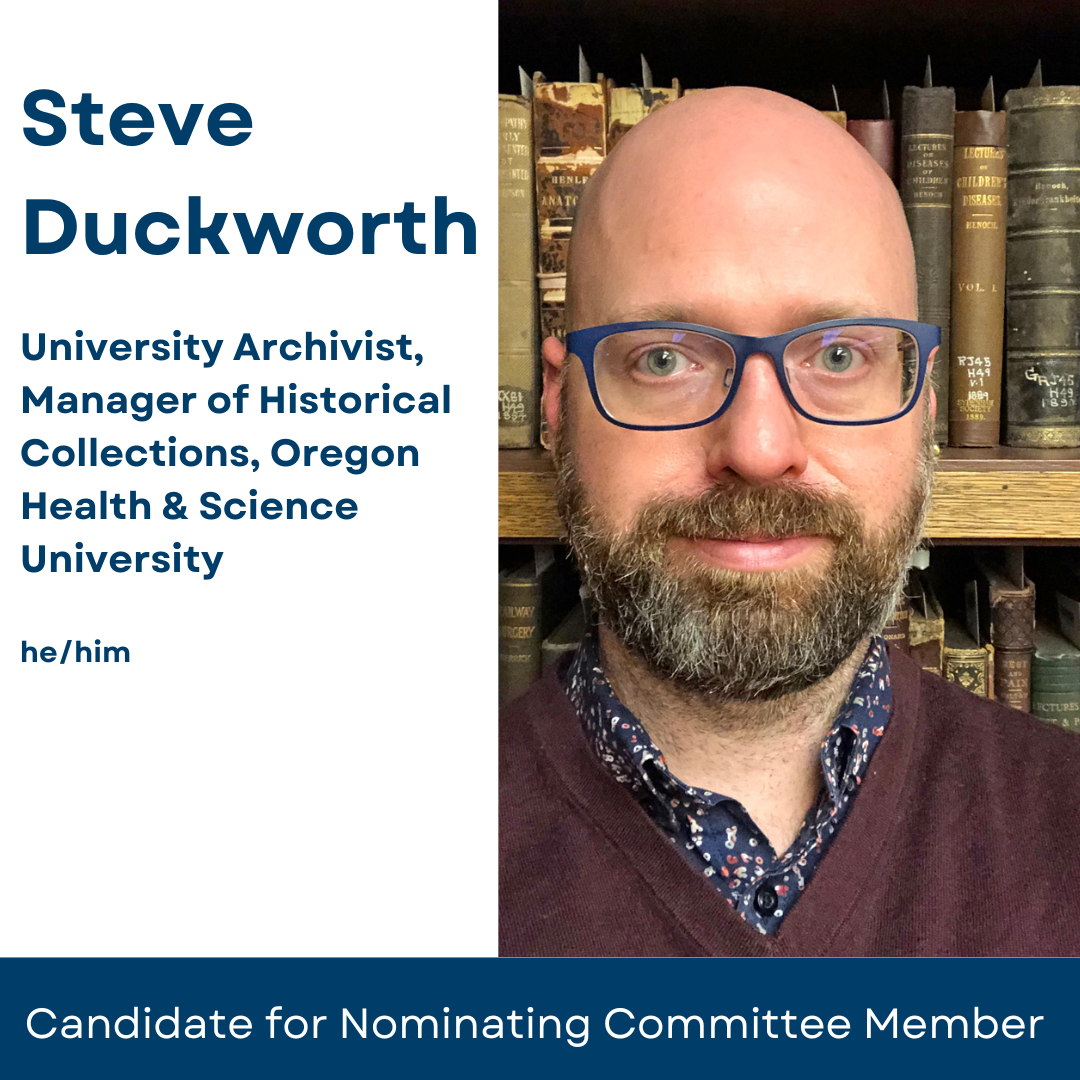
"I hope to be cultivating, along with many others in the profession who are doing so much more than me, a growing population of archivists who question norms and seek out new perspectives and voices."
I came to archives as a second career. After college, I spent a bit over a decade working as a freelance cellist and teacher. Once I made it to my 30s, I began to ponder if I could sustain that lifestyle for the rest of my life; turns out it's hard to make a living in the arts and it's very stressful to be poor in America. I looked into other professions that could offer appealing work along with some of the capitalist comforts I'd been missing: some level of covered healthcare costs, paid time off, retirement savings – you know, the little things that could help lower that stress level. I found myself focused on library science as I had a love of systems and organizational thinking, and I chose to focus on archives on a bit of a whim. And it's seemingly worked out well. I got my MLIS at Drexel in Philadelphia; I worked on a PACSCL project there before moving to Alaska for my first "real" (though temporary) job. Alaska was followed by a move to Florida (the place where I grew up), and then one more move across the country to Portland, OR.I'm still working in that job – University Archivist at Oregon Health & Science University – and am now some sort of mid-career professional who finds myself focused on how to make the profession more accessible and welcoming, more diverse, more inviting. I've served on the SAA Diversity Committee and the Steering Committees of the Issues & Advocacy Section and the Accessibility & Disability Section. I was an organizing member of the Archival Workers Collective. I've taught in archives programs as an adjunct instructor, and I have managed and mentored a significant number of archives graduate students during my time in Oregon.
(Each candidate prepared a diversity statement according to SAA guidelines.)
I think diversity in all things is amazing. Equity, inclusion, accessibility, belonging – whatever words we continuously add to the lineup – all seem to be striving to help people figure out just exactly how to treat other humans as fellow humans and they often fall short of people's higher goals. For me, all of this can be simplified to the idea that people should be treated with compassion and humanity. We should take care to provide for others what they need to succeed and thrive, and we should constantly work to break down the barriers that hinder that success. My own personal story of diversity stems from being an awkward gay kid who grew into an awkward gay adult who turned out to also be autistic all along. The experiences I've had in life relating to these aspects, as well as other issues that have made me feel marginalized, cannot be separated out from my professional persona. So that carries through to everything I do in some way. When conducting archival appraisal or processing collections, I consider what hidden stories the collections may tell (or whose stories they may be subverting). With the students I mentor, I invoke an ethics of care model while teaching them the tenants of archival theory and practice (and to questions those tenants for themselves). I do the same when teaching an Intro to Archives course – highlighting voices of a diverse set of people in the profession and the history of erasure and ignorance that the archival record has prized. And I continue to seek out new opportunities to learn from people who know more and differently than myself – to never stop moving towards the goal of true diversity, equity, and belonging. I hope to be cultivating, along with many others in the profession who are doing so much more than me, a growing population of archivists who question norms and seek out new perspectives and voices. I know I prefer working with people that embody these same ideals – even if how we enact them is as diverse as the humanity we all hope to document. And I plan to bring these same practices and ideals to the Nominating Committee, if elected.
The Nominating Committee plays a crucial role in shaping the elected leadership of SAA. Share your strategies for inspiring members to participate in running for leadership positions and engaging in the election process. How will you ensure a slate of candidates that support an awareness of the role of power, positionality, inclusion, and belonging in our Society?
CANDIDATE'S RESPONSE
Something I think is important to building a robust and diverse slate of candidates to serve in SAA roles is to help people understand that there is a place for them in the leadership of the Society and that SAA needs to do some work to make those roles more accessible to people, in addition to simply inviting people to run. Some people may offer amazing perspectives, but their job doesn't allow them to take time for professional service. What are some ways SAA could make that feasible for those people? Others may not mesh well with the structure of committees or think the workload is too much to handle. How can SAA and others work to make those structures more welcoming or decrease the amount of work each person has to do? What support can SAA give to these leaders to help them be more efficient and impactful? Many others are disenfranchised with SAA and feel their time and effort is better placed with other work or other groups. What can SAA do to build trust with its members and to make changes that are seen as truly beneficial to the profession? As a Nominating Committee member, I would aim to recruit great candidates – like many Committee members before me – but I think it's also imperative to gather feedback from people who choose not to run – to learn why and to see what can be changed within SAA to improve that outcome in the future.
The Nominating Committee has slated the following SAA members as candidates for office in the 2025 election: